The Siege of Jerusalem and the Destruction of the Second Temple
The end of an age.

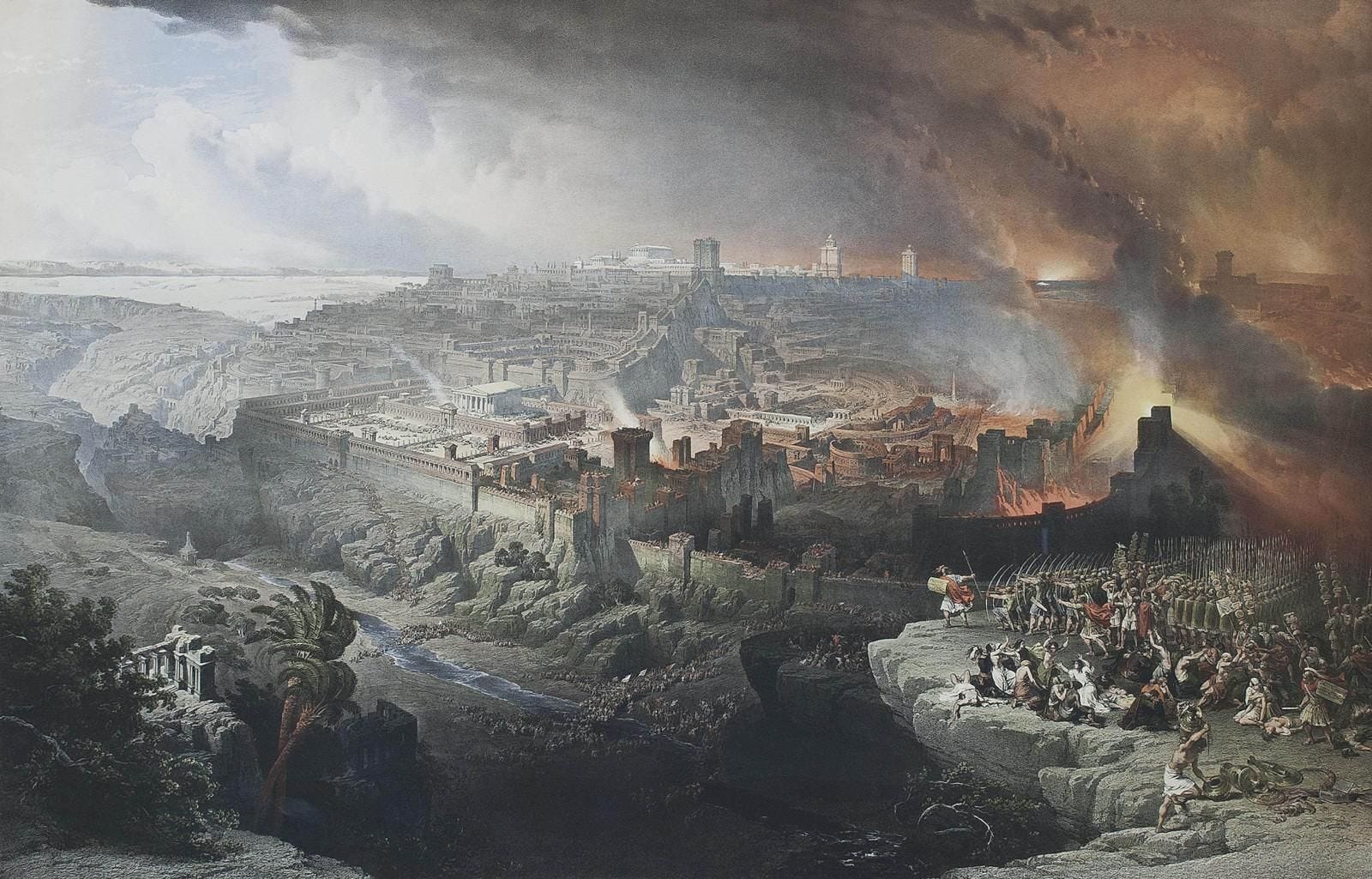
The Siege of Jerusalem is one of, if not the most consequential event in history. It was preceded by numerous supernatural omens. Jesus, in his Olivet discourse tells everyone to watch for the astrological signs, and omens, that will foretell the destruction of the Temple: “And there shall be signs in the sun, and in the moon, and in the stars.” [Luke 21:25] Josephus records these:
Thus were the miserable people persuaded by these deceivers, and such as belied God himself; while they did not attend nor give credit to the signs that were so evident, and did so plainly foretell their future desolation, but, like men infatuated, without either eyes to see or minds to consider, did not regard the denunciations that God made to them. Thus there was a star resembling a sword, which stood over the city, and a comet, that continued a whole year. Thus also before the Jews' rebellion, and before those commotions which preceded the war, when the people were come in great crowds to the feast of unleavened bread, on the eighth day of the month Xanthicus, [Nisan,] and at the ninth hour of the night, so great a light shone round the altar and the holy house, that it appeared to be bright day time; which lasted for half an hour. This light seemed to be a good sign to the unskillful, but was so interpreted by the sacred scribes, as to portend those events that followed immediately upon it. At the same festival also, a heifer, as she was led by the high priest to be sacrificed, brought forth a lamb in the midst of the temple. Moreover, the eastern gate of the inner [court of the] temple, which was of brass, and vastly heavy, and had been with difficulty shut by twenty men, and rested upon a basis armed with iron, and had bolts fastened very deep into the firm floor, which was there made of one entire stone, was seen to be opened of its own accord about the sixth hour of the night. Now those that kept watch in the temple came hereupon running to the captain of the temple, and told him of it; who then came up thither, and not without great difficulty was able to shut the gate again. This also appeared to the vulgar to be a very happy prodigy, as if God did thereby open them the gate of happiness. But the men of learning understood it, that the security of their holy house was dissolved of its own accord, and that the gate was opened for the advantage of their enemies. So these publicly declared that the signal foreshowed the desolation that was coming upon them. Besides these, a few days after that feast, on the one and twentieth day of the month Artemisius, [Jyar,] a certain prodigious and incredible phenomenon appeared: I suppose the account of it would seem to be a fable, were it not related by those that saw it, and were not the events that followed it of so considerable a nature as to deserve such signals; for, before sun-setting, chariots and troops of soldiers in their armor were seen running about among the clouds, and surrounding of cities. Moreover, at that feast which we call Pentecost, as the priests were going by night into the inner [court of the temple,] as their custom was, to perform their sacred ministrations, they said that, in the first place, they felt a quaking, and heard a great noise, and after that they heard a sound as of a great multitude, saying, "Let us remove hence." But, what is still more terrible, there was one Jesus, the son of Ananus, a plebeian and a husbandman, who, four years before the war began, and at a time when the city was in very great peace and prosperity, came to that feast whereon it is our custom for every one to make tabernacles to God in the temple, began on a sudden to cry aloud, "A voice from the east, a voice from the west, a voice from the four winds, a voice against Jerusalem and the holy house, a voice against the bridegrooms and the brides, and a voice against this whole people!" This was his cry, as he went about by day and by night, in all the lanes of the city. However, certain of the most eminent among the populace had great indignation at this dire cry of his, and took up the man, and gave him a great number of severe stripes; yet did not he either say any thing for himself, or any thing peculiar to those that chastised him, but still went on with the same words which he cried before. Hereupon our rulers, supposing, as the case proved to be, that this was a sort of divine fury in the man, brought him to the Roman procurator, where he was whipped till his bones were laid bare; yet he did not make any supplication for himself, nor shed any tears, but turning his voice to the most lamentable tone possible, at every stroke of the whip his answer was, "Woe, woe to Jerusalem!" And when Albinus (for he was then our procurator) asked him, Who he was? and whence he came? and why he uttered such words? he made no manner of reply to what he said, but still did not leave off his melancholy ditty, till Albinus took him to be a madman, and dismissed him. Now, during all the time that passed before the war began, this man did not go near any of the citizens, nor was seen by them while he said so; but he every day uttered these lamentable words, as if it were his premeditated vow, "Woe, woe to Jerusalem!" Nor did he give ill words to any of those that beat him every day, nor good words to those that gave him food; but this was his reply to all men, and indeed no other than a melancholy presage of what was to come. This cry of his was the loudest at the festivals; and he continued this ditty for seven years and five months, without growing hoarse, or being tired therewith, until the very time that he saw his presage in earnest fulfilled in our siege, when it ceased; for as he was going round upon the wall, he cried out with his utmost force, "Woe, woe to the city again, and to the people, and to the holy house!" And just as he added at the last, "Woe, woe to myself also!" there came a stone out of one of the engines, and smote him, and killed him immediately; and as he was uttering the very same presages he gave up the ghost.
Jesus constantly prophesied about Jerusalem falling. In his dialogue with the Samaritan Woman, in John 4, he prophesies about the Temple’s destruction and a future where people “worship in spirit” rather than being tied to temple and location. Then His Olivet Discourse is where Jesus expounded on this prophecy. His disciples are admiring the Temple when Jesus tells them it will be destroyed. Further, the only recorded words while carrying the cross was a prophecy about Jerusalem being destroyed.
27 And there followed him a great multitude of people, and of women, who bewailed and lamented him. 28 But Jesus turning to them, said: “Daughters of Jerusalem, weep not over me; but weep for yourselves, and for your children. 29 For behold, the days shall come, wherein they will say: Blessed are the barren, and the wombs that have not borne, and the paps that have not given suck. 30 Then shall they begin to say to the mountains: Fall upon us; and to the hills: Cover us. 31 For if in the green wood they do these things, what shall be done in the dry?”
This is the event that ended Judaism as a religion with divine vitality. Judaism no longer has priests because of this event. Their magic failed after this.
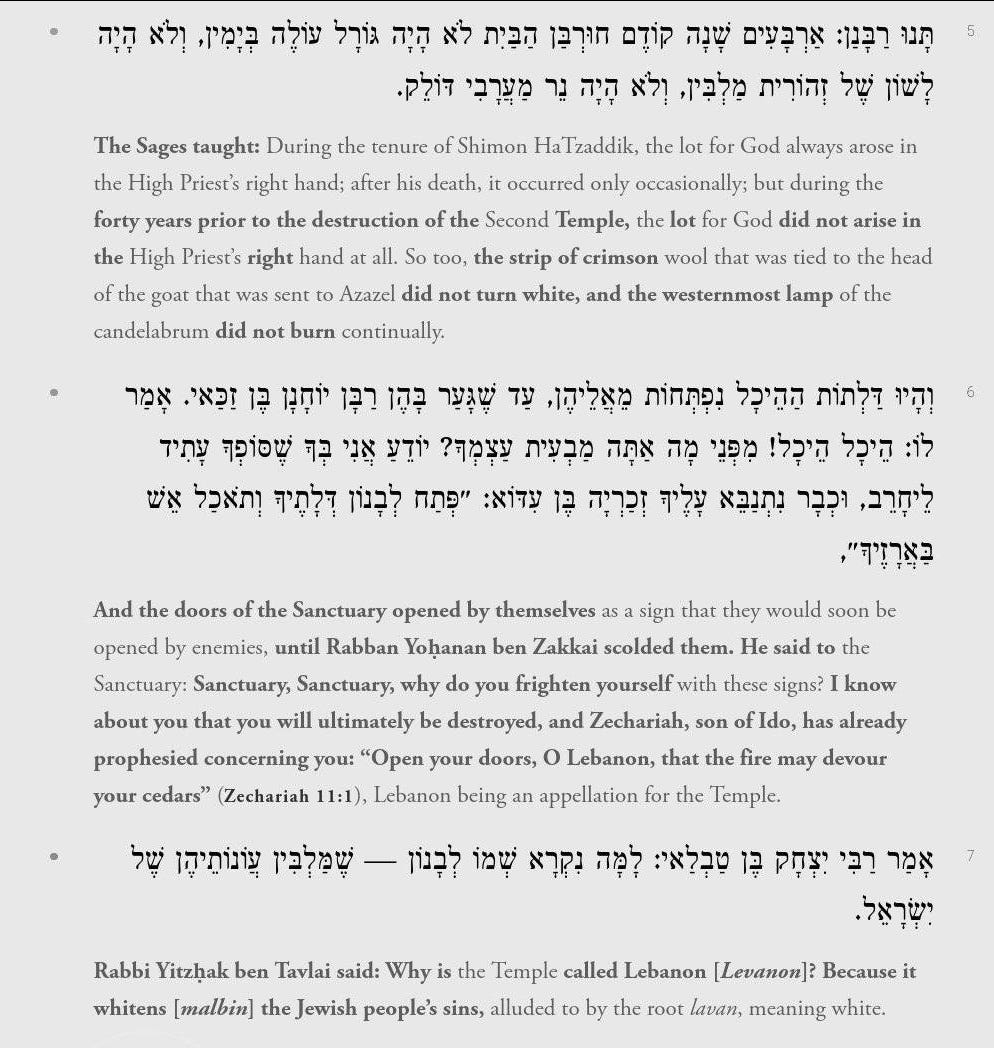
This ended Judaism as the divine religion and entered the Christian age. Judaism was a temple religion. Sacrificial worship could only happen at the Temple. Destroying the temple ended the religion.
The siege is timed for the penumbra eclipse. The eclipse is conjunct Saturn. “Day (Sun) of Siege (Saturn).” It is also conjunct Neptune. “Day Religion (Neptune) Ends.” Or, more dramatically, “Day Everyone Dies/Starves.” The siege was a dramatic event where the citizens starved and died. The siege began under an eclipse. Eclipses interrupt the electromagnetic waves to the earth. It’s like turning off the earth’s power supply and quickly turning it back on. Eclipses change the earth.
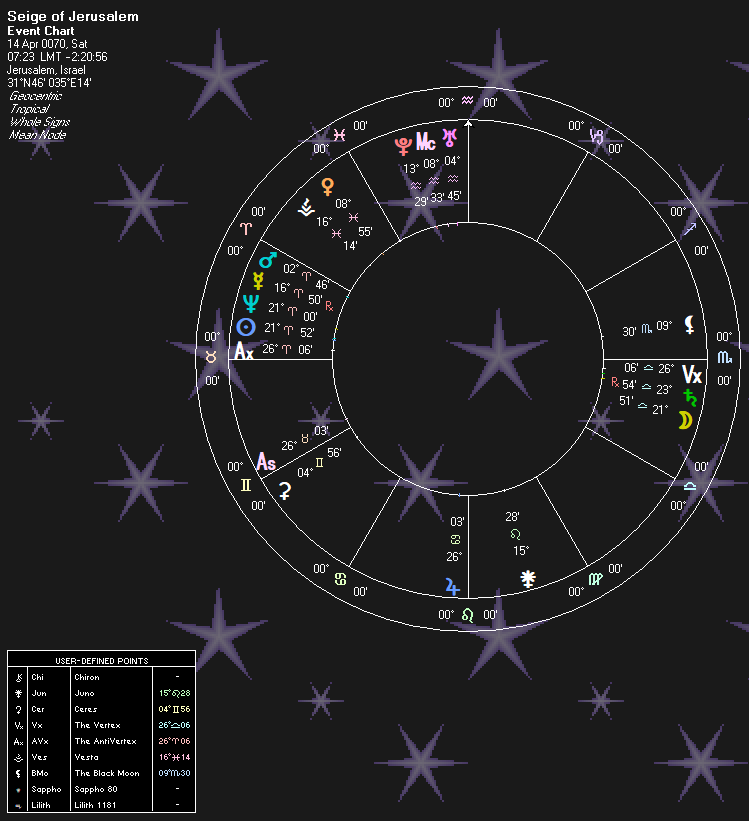
Penumbral eclipse. Blood moon.
SECOND TEMPLE DESTROYED
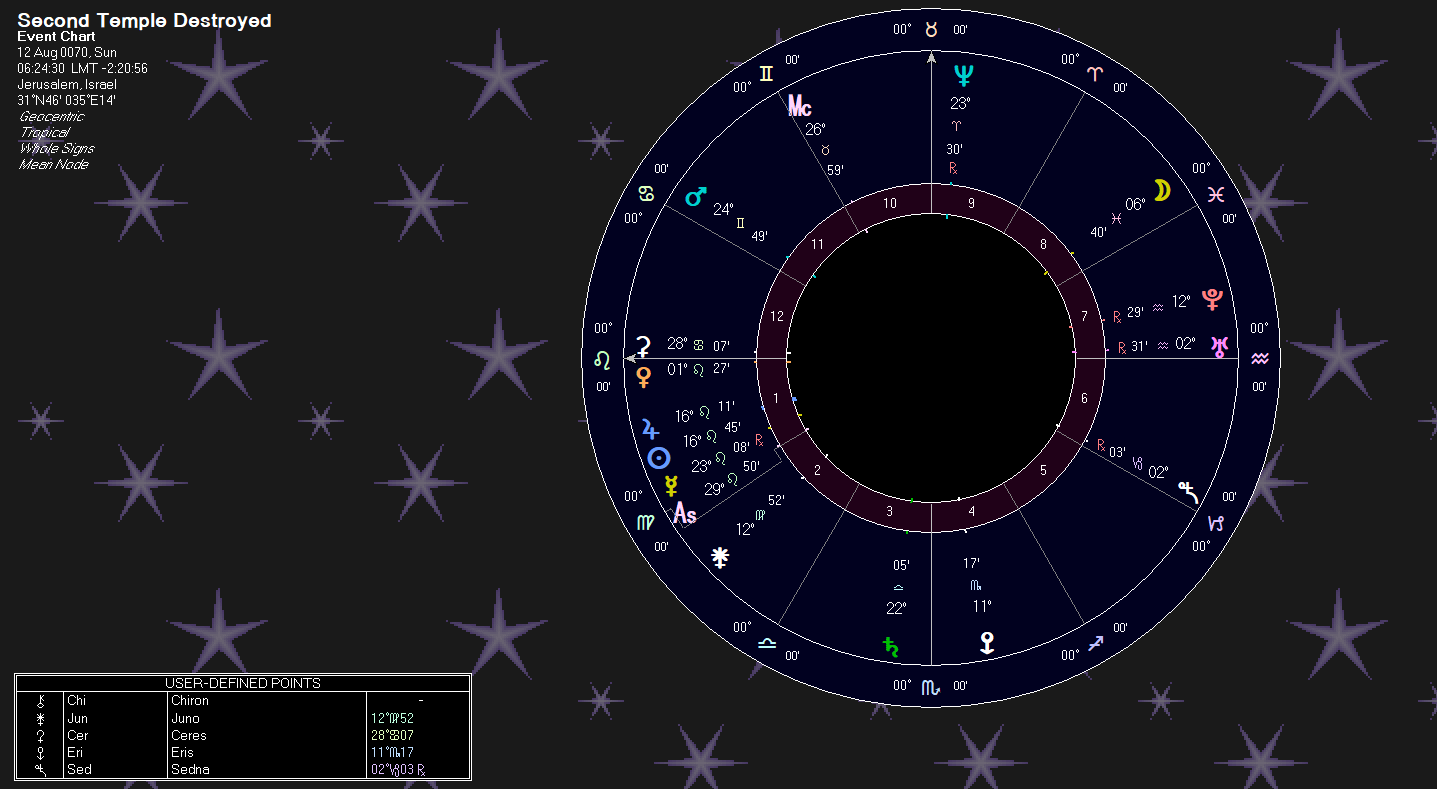
This date is timed for the Medium Caeli to align with the siege eclipse’s Ascendant. This gives a 0’33” conjunction between Sun and Jupiter at 16 Leo.
Neptune stationed 13 days ago retrograde. The gas giants’ stations are powerful. They disrupt the electromagnetic waves on earth. Their effects last a few weeks around the stations disrupting events on earth.
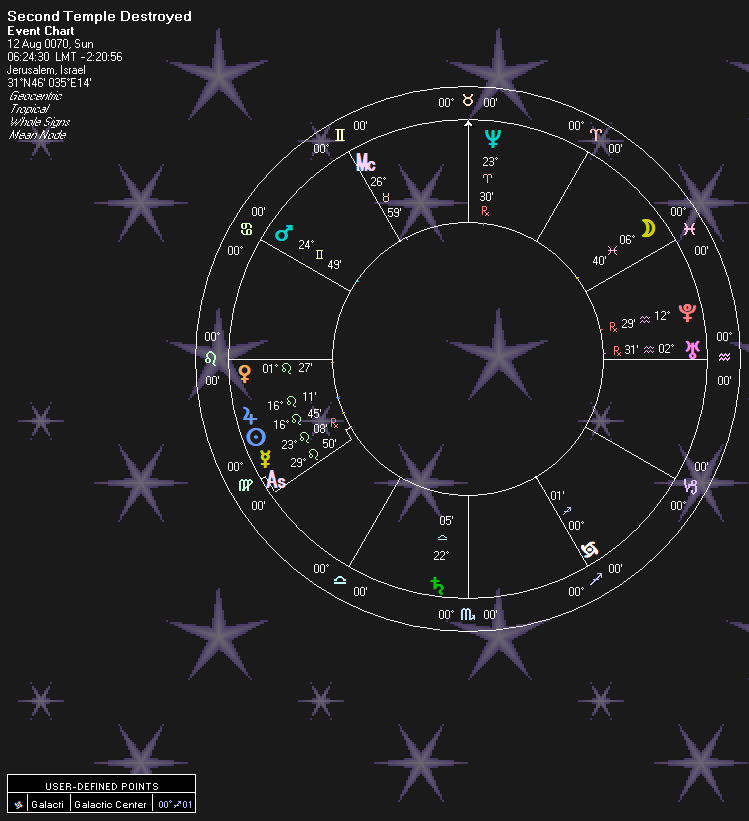
Galactic Center ingressed Sagittarius on 28 April 69AD, a few days after the start of the Siege.
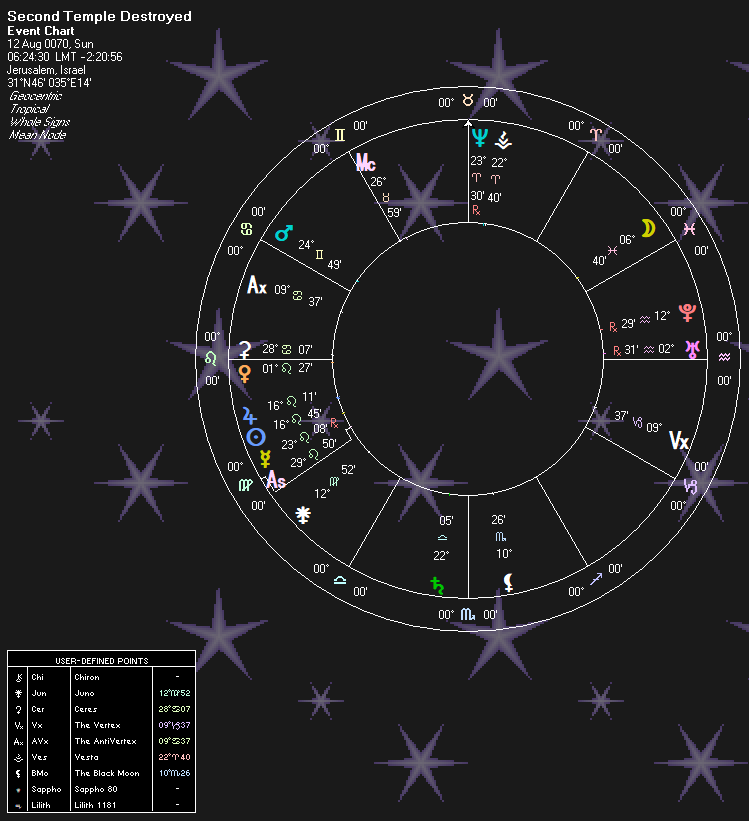
Saturn oppose Neptune and Vesta = “End (Saturn) Religion (Neptune and Vesta).”
Sun conjunct Jupiter in Leo = “Religion (Jupiter) In Flames (Sun).” The Sun will often be in hard aspect to show arson. In fact, it is in every arson case I see. Mars sextiles Neptune = “Burn Religion.” Mars is also trining Saturn. Together this creates “Burn (Mars) Religious (Neptune) Structure (Saturn).”
Pluto is in opposition to the Sun-Jupiter conjunct. Pluto is destruction and also atrocities. “Day (Sun) of Destruction (Pluto).”
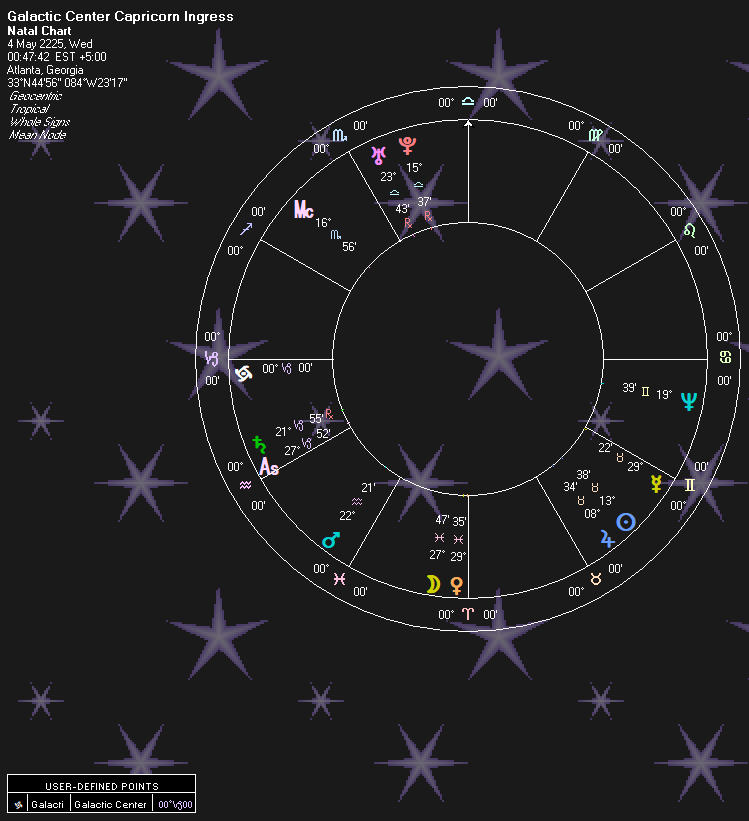
This is the true meaning of the Galactic Center: It is an epoch marker. In mundane astrology, the time an object spends in a sign shows its influence. The Moon gives the theme of the day, Mars and Venus flavor of the month, Saturn and Jupiter span years, the outer planets cover the generations. The farthest out objects, such as Sedna, can flavor a century. The Galactic Center covers 2,000 years. Epochs. Thus, in mundane astrology, the Galactic Center is showing the start of the Christian era.
The Galactic Center will exit Sagittarius on May 4, 2225, 00:47:42.