

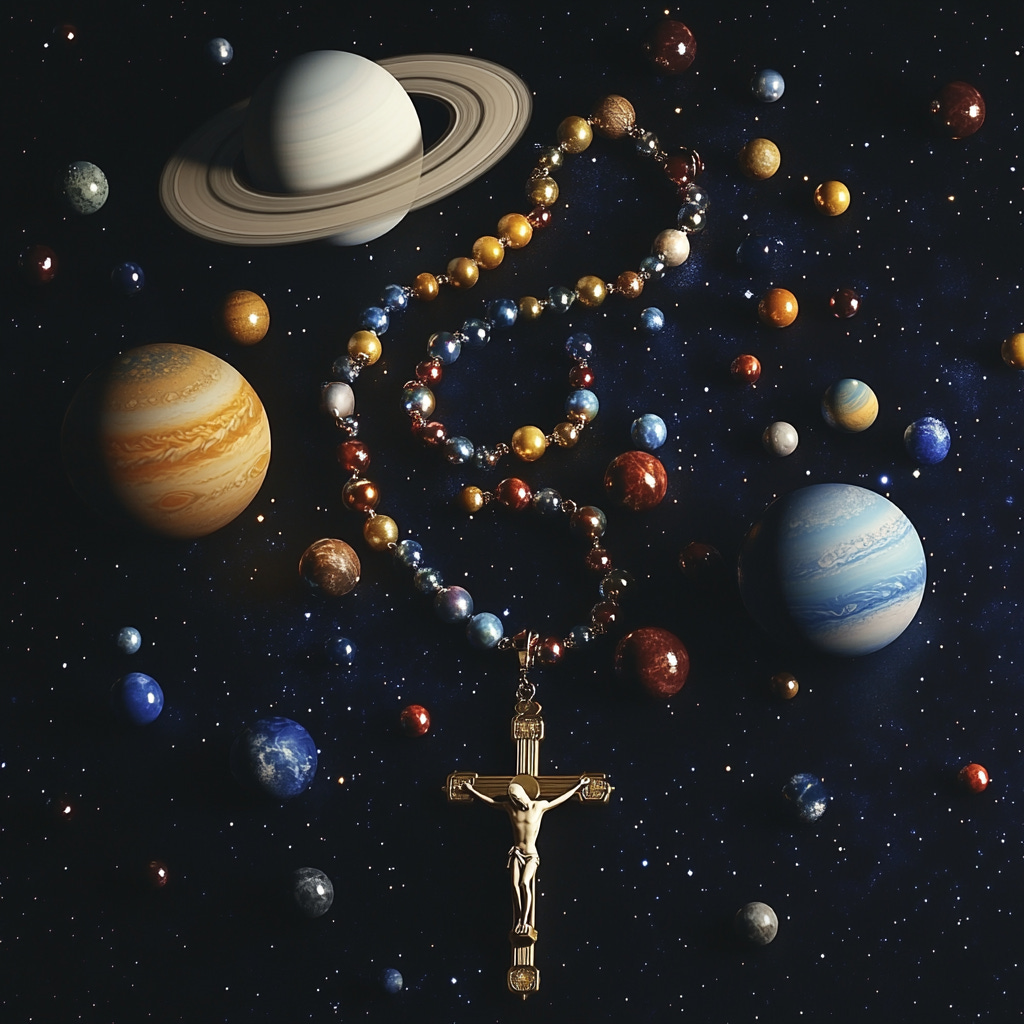
I previously covered the Liturgy of the Hours and its relation to astrology. There is also the Catholic weekday devotions. This system is something that developed over the centuries. While Sunday and Friday were always devoted to Jesus, the rest of the days developed over time. Catholics soon devoted other days of the week to other devotions.
Sundays are devoted to Jesus’ Resurrection.
Mondays are devoted to the Souls of Purgatory.
Tuesdays are devoted to the angels.
Wednesdays are devoted to St. Joseph.
Thursdays are devoted to the Eucharist.
Fridays are devoted to Jesus’ passion.
Saturdays are devoted to Mary.
This system is also overlayed with the rosary mysteries. The rosary is a devotion of rote prayers combined with meditation on Christ’s life called “mysteries.” It developed over centuries. Currently the mysteries are split between the “traditional” system, and the current. The mysteries are prayed according to the days of the week.
Trad Rosary Mysteries:
Sundays - Glorious Mysteries. The Ressurection of Jesus, and the Ascensions of Jesus and Mary and her Coronation.
Mondays - Joyous Mysteries. Jesus’ conception, nativity, and childhood.
Tuesdays - Sorrowful Mysteries. Jesus’ Passion.
Wednesdays - Glorious Mysteries
Thursdays - Joyous Mysteries
Fridays - Sorrowful Mysteries
Saturdays - Glorious Mysteries.
The current rosary was instituted by Pope St. John Paul II in 2002. It added the Luminous Mysteries which cover Jesus’ ministries. This shifted the schedule for the mysteries. They now look like this:
Sunday - Glorious Mysteries of the Rosary
Monday - Joyful Mysteries of the Rosary
Tuesday - Sorrowful Mysteries of the Rosary
Wednesday - Glorious Mysteries of the Rosary
Thursday - Luminous Mysteries of the Rosary
Friday - Sorrowful Mysteries of the Rosary
Saturday - Joyful Mysteries of the Rosary
Now we will compare these devotions to the Planetary Days. This is an ancient system, going back to the origins of astrology. It is comes from the Planetary Hours, which rotates the hour’s planetary ruler. Each day, the first hour’s ruler gives the Day’s ruler. This is where we get the names for our days of the week from.
Sunday - Sun
Monday - Moon
Tuesday - Mars
Wednesday - Mercury
Thursday - Jupiter
Friday - Venus
Saturday - Saturn
This can be correlated with the Catholic devotionals. It’s not perfect, but is interesting to look at.
SUNDAY
Day of the Sun. The Sun is the attributes of God. Immortality, Everlasting, Light, Glory. This is the day of worship. Specifically, it is about Jesus’ Resurrection. Jesus is the sol invictus: The Unconquerable Sun. In the rosary, we meditate on all these themes of resurrection, ascension, and immortality.
MONDAY
Moon Day. The Church devotional are the souls of Purgatory. The rosary mysteries are Jesus’ birth and childhood. Purgatory is the dead, specifically the ghosts of the dead. Ghosts are the purgatorial souls. The Moon covers ghosts and phantoms. The Moon’s theme is also night, which is where we often think of and see ghosts. “Nightmare” is another attribute of the Moon. The first Joyful Mystery is the Annunciation which announces Jesus’ conception. Conception is a lunar attribute. So is “gestation.” That is the Second Joyful Mystery: The Visitation where pregnant Mary met pregnant Elizabeth and the babies recognized each other in the womb. Moon is also “mother.” Mary’s motherhood is a theme in every Joyful Mystery.
TUESDAY
Mars’ Day. Angels. Most Catholics devote Tuesdays to the Archangels, Michael being the most popular, or their Guardian Angel. Angels are protectors, a Mars theme. St. Michael is pretty much the Catholic war god. He is the patron saint of every military and paramilitary branch. Anything to do with fighting he is the patron saint of. In the rosary, we cover the Sorrowful Mysteries. These are the bloody and violent mysteries of Christ’s passion. Mars is blood and violence.
WEDNSDAY
Mercury. This one is not a perfect match in Catholic devotion. The devotion is a late one. St. Joseph. St. Joseph was not a popular devotion until the 15th Century. St. Joseph doesn’t say a line in scripture. He’s not a Mercurial figure. The Rosary devotion are the Glorious Mysteries. Sunday is a better day for those.
THURSDAY
Jupiter. Devotion to the Eucharist. God in the flesh. Jupiter is about God and holy things. In the trad Rosary, we return to the Joyful Mysteries of baby Jesus. This can work as meditation on God, but I like the Luminous Mysteries better for Jupitarian themes. In the Joyful Myseries, you are looking Lunar themes of Motherhood and conception. With the Luminous Mysteries you do get Jupiter themes out of Jesus’ ministry, including the institution of the Eucharist that Thursdays are devoted to. In fact, Johndro has “ministry” as Jupiter theme. Many of the Luminous Mysteries are announcing Jesus as God. The Baptism has God announcing from Heaven that Jesus is the succosor king (Jupiter) to King David (“beloved Son” being a Davidic king title). The Third Mystery is Jesus’ proclamation of Kingdom (Jupiter) of God. The Fourth is Jesus’ Transfiguration where he displays his divinity (Jupiter). And then we have the Eucharist.
FRIDAY
Venus. Fridays have always been about Christ’s Passion. Venusian or not, that is what Fridays are. What is fascinating is that Johndro’s dictionary includes both “Blood” and “Passion Play” under Venus. Perfect.
SATURDAY
Saturn Day. This is Christ in the tomb. While, the devotional day is Marian, there has always been an underlying Catholic remembrance of Jesus in death and Hell on Saturday. These are Saturnian themes and fit better than Mary and her Sacred Heart. You can however, combine the themes and remember Mary’s sorrow at Jesus’ death. In the trad rosary, Saturay is Glorious Mysteries of resurrection and assumption. In the current rosary it is the Joyful Mysteries. With the Glorious Mysteries, you are using Saturday to anticipate the resurrection. With Joyful, you are looking back to the nativity. I give the Joyful Mysteries the edge, here, because half of them Jesus is in Mary’s womb, and I mark the womb as Saturnian and many Catholic thinkers note a typology between Jesus gestation and birth with his tomb. St. Pope John Paul the Second wins again. The new rosary is more aligned with the planets than the old.