Close to the stripped and wretched little oak, at the chill and sunless noontime of a soggy day, the children wait. The girls seem fragile and pathetic in their fancy clothes. Francisco's Sunday suit hangs wet and baggy on his little frame. The strong denunciations by the unnamed priest still echo with the timbre of his rage. Lucia's father and mother are near, and many of their friends are close at hand. Ti Marto stands in watchful readiness, though his wife, Olimpia, is somewhere in the jumble of the crowd. Dr. Formigao maintains his vigil; Maria da Capelinha is here—pious, of course, and nervous, wishing perhaps to light another candle, or to hang just one more pretty ribbon in hope it will entice the Lady to appear.
The rain continues, and by the official government time it is well past one o'clock. But by sun time it is precisely noon when Lucia looks to the east. "Jacinta," she says softly, "kneel down." Then more strongly she calls, "Our Lady is coming; I have seen the lightning."
The children kneel, as do countless numbers of the faithful; but the people as yet have been stirred by no great happening. The faces of the children are mirrors of ecstasy, yet what they see is not for other eyes to know, except through the testimony of the children themselves.
Their Lady stands in unearthly beauty above the bright flowers and rain-wilted ribbons of silk that affectionate hands have fixed there in her honour. But flowers fade and sunlight pales, and every natural glory of earth withdraws its poor pretensions in her company, if we can believe her witnesses.
Now we find that by God's gift, it is almost impossible not to believe.
"What do you want of me?" asks Lucia
The dialogue, read this way, does not seem inspired. From May to October it has been much the same. But there is this significant difference. It is heaven and earth concerned with goodness, rather than with skills. There is no call for Dante, or for Shakespeare, or for any modern literary hand.
"I want a chapel built here in my honour. I want you to continue saying the Rosary every day. The war will end soon, and the soldiers will return to their homes."
"Yes," says Lucia "Yes." But since the Lady has promised this day to tell exactly who she is, Lucia asks further,
"Will you tell me your name?"
"I am the Lady of the Rosary."
There is a reverent silence. Lucia then explains, "I have many petitions from many people. Will you grant them? "
"Some I shall grant, and others I must deny." This Lady of the Rosary, who is God's Mother, is gentle, but she is serious. She has never smiled- She is asking for penance. She is talking in terms of heaven and hell—a blunt and terrifying equation that so many have comfortably forgotten. She speaks as though after 1900 years, a cross still weighs upon the shoulders of her Son: "People must amend their lives and ask pardon for their sins. They must not offend our Lord any more, for He is already too much offended! "
"And is that all you have to ask?" Lucia inquires.
"There is nothing more."
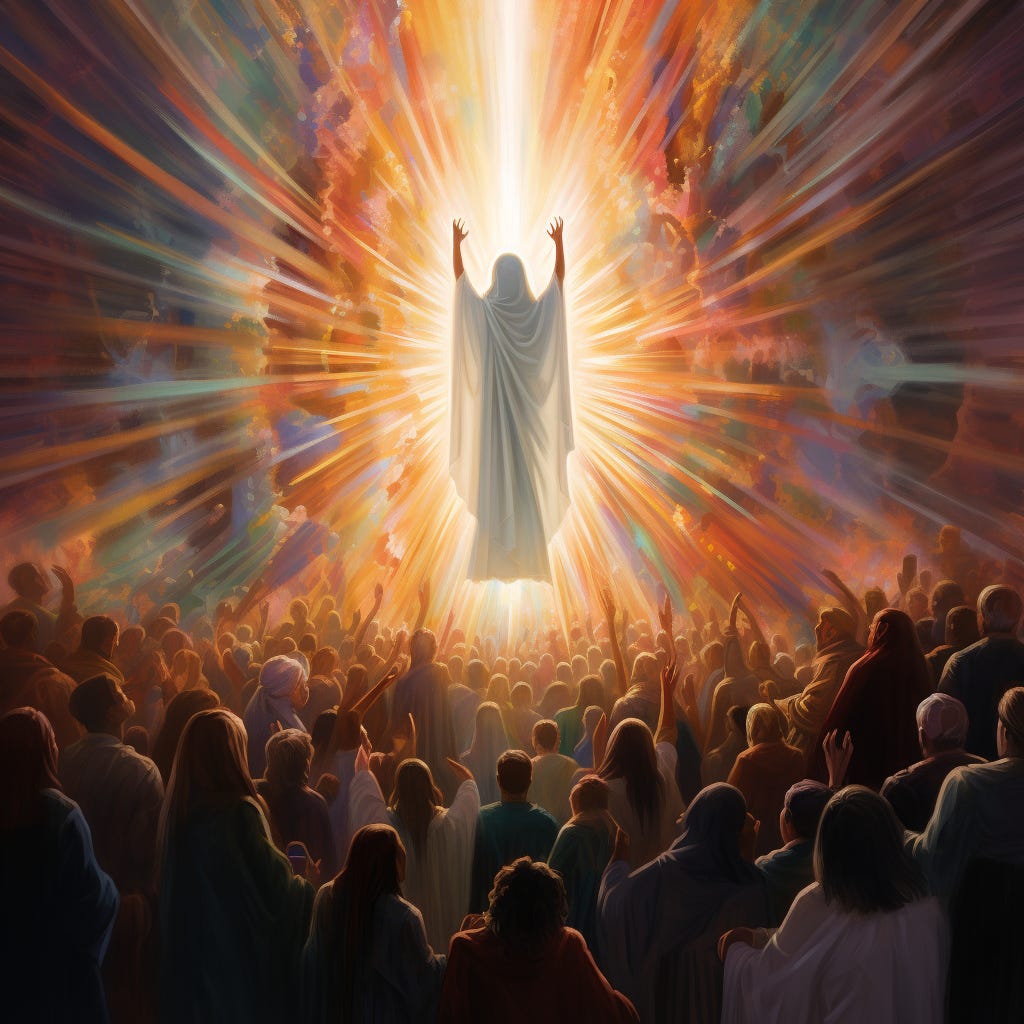
Now the Lady of the Rosary takes her last leave of her three small friends. She rises slowly toward the east. The children behold how she turns the palms of her gentle hands to the dark sky over them, and now, as if this is a signal, the rain has stopped; the great dark clouds that have obscured the sun and depressed the solemn day, are suddenly burst apart; they scatter; they are rent like a bombed rainbow before the eye, and the bold sun hangs unchallenged in its place, a strangely spinning disc of silver.
Lucia, Jacinta and Francisco are beholding their Lady. From her upturned hands strange rays of light are rising, as though to assault and make dim the light of the sun itself.
Lucia cries out a single time, "Look at the sun!"
But she has no recollection later of having called this out to the crowd. The Lady of the Rosary is no longer ascending. She stands in glory to the right of the sun, and her light is such that the great fixed star is by comparison pallid and weak. For a moment she is gowned in white, precisely as the children have known her each time she has appeared above the stubby oak. Yet as quickly, and as strangely then, she is wearing a mantle of blue, and with her, in fidelity to the promise she has made, is St. Joseph, with the Christ Child in his arms. St. Joseph is robed in red, and he appears to lean from the clouds, holding the Child who also is dressed in red.
These visions are brief and they succeed one another rapidly. Three times St. Joseph has traced the sign of the cross above the people. St. Joseph fades away, and Christ appears at the base of the sun. He is cloaked in red. With Him stands His Mother. She is gowned now in neither white nor blue, but as Our Lady of Sorrows, gazing on the earth. She has not the traditional sword in her heart. This the children clearly note, and are later able to recall. Christ gives his blessing to the people, and then, as this vision passes, there is one that Lucia alone is privileged to see: Our Lady of Mount Carmel.
Remember, this is Lucia speaking; this is the privileged sight of three, quite different from the shocking and indisputable phenomenon that is witnessed by the crowd.
It seems strange, recounting here in simple words, such prodigies as this. There can be no attempt to describe the impact of this experience on the children. They have themselves no more succeeded in this than they have managed fully to convey a picture of the Lady whose beauty was more than the senses, unaided, could properly comprehend.
But what of the crowd who did not see the Christ Child, or His Mother, or St. Joseph in the sky? Here the record pursues the sceptic, and inexorably, if he does not flee from the evidence, it will defeat him. The miraculous hand falls heavily. Like stones, the signs of God will be laid before you now to build a house of faith.
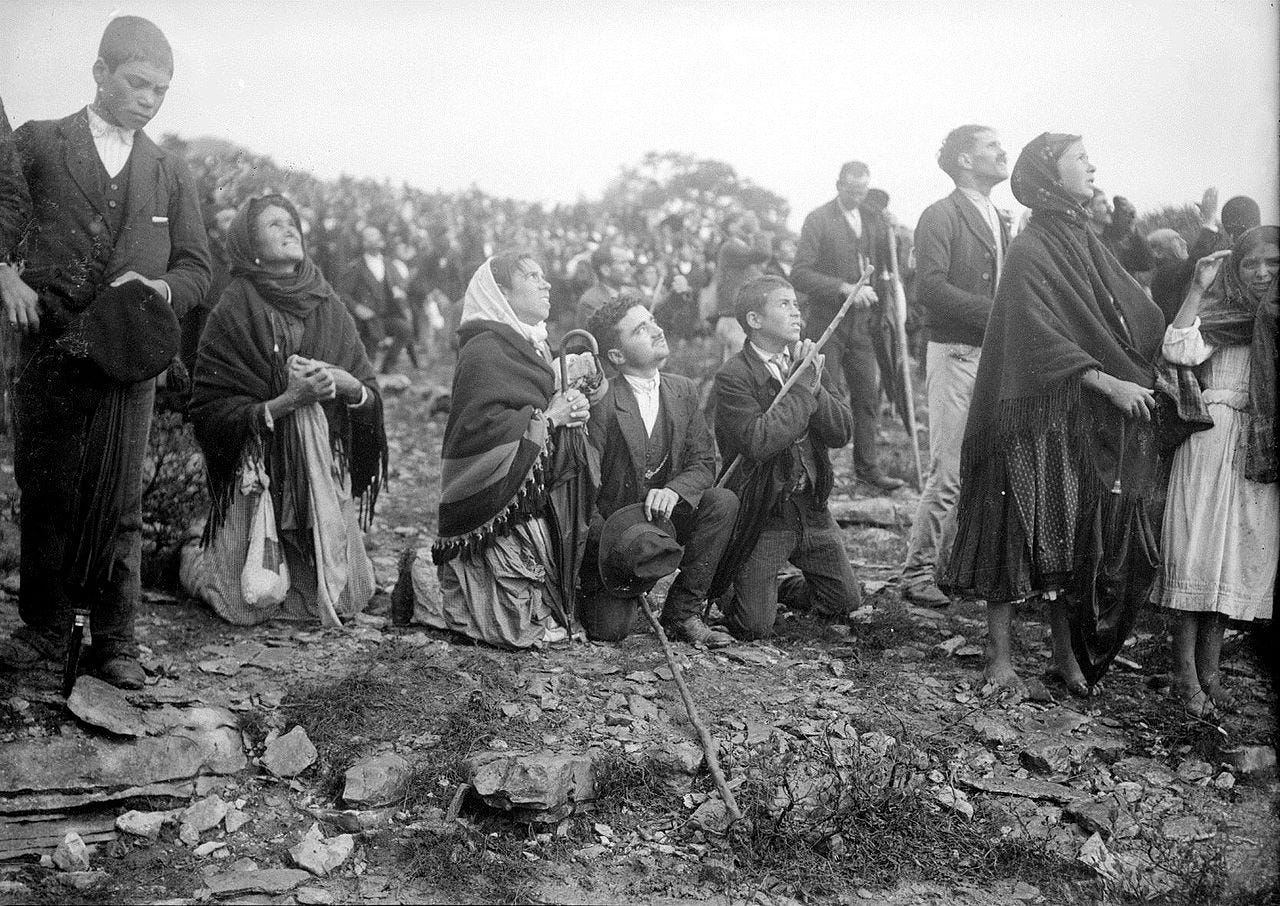
When Lucia cried, "Look at the sun!" the people responded. The rain at that moment had stopped; the sun was clearly seen. There was no cloud to obscure it, yet it did not strain the eyes of any man to look on its unveiled light. The people could see that the sun was strangely spinning. It began to revolve more rapidly, more frighteningly. It began to cast off beams of many-colored lights in all directions. Shafts of brilliant red came from the rim of the revolving star and fell across the earth, the people and the trees; and green lights came and violet and blue in mixed array. It is a story of wonder and of terror, too, as the great star challenges the discipline of all the ages it has known, and begins careening, trembling in the sky for seventy thousand witnesses to see. Now, horribly, it appears to plunge from its place in the heavens and fall upon the earth. People are crying:
"I believe! I believe!"
They are shrieking, "Jesus, save us!"
They are crying, "Miracle!"
They are begging, "God forgive us our sins!"
They are praying, "Mary, save us!"
This is, of course, not our story to tell. It is the story of the seventy thousand people who were there. It appears more prudent to call them in witness, than to belabour the subject ourselves. We will start with our friend, Ti Marto, who is not an excitable man:
We looked easily at the sun, which for some reason did not blind us. It seemed to flicker on and off, first one way, then another. It cast its rays in many directions and painted everything in different colours—the trees, the people, the air and the ground. But what was most extraordinary, I thought, was that the sun did not hurt our eyes. Everything was still and quiet, and everyone was looking up. Then at a certain moment, the sun appeared to stop spinning. It then began to move and to dance in the sky until it seemed to detach itself from its place and fall upon us. It was a terrible moment.
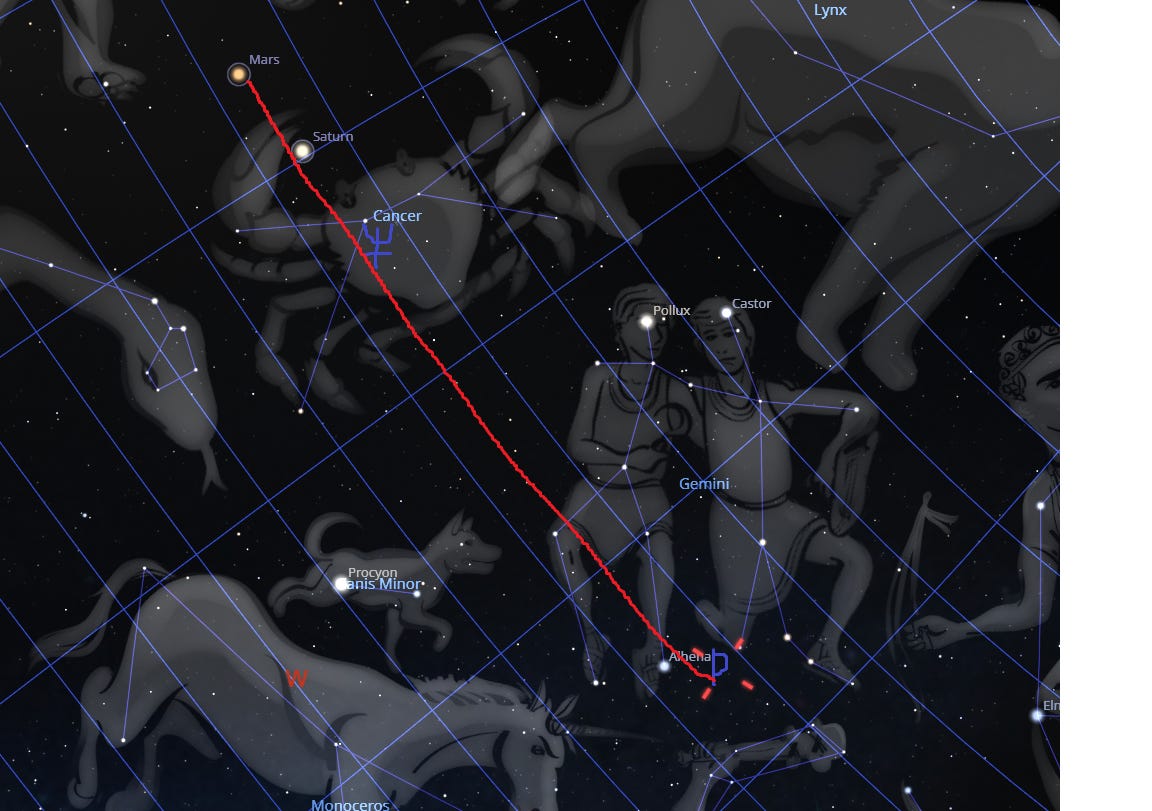
The entirety of the Fatima Appearances contained a stellium in declination: Mars, Saturn, Neptune, and Pluto are all lined up on the same celestial latitude. This is what the parallel looked like at the Miracle of the Sun.
Thanks for reading Astrology of the Saints! Subscribe for free to receive new posts and support my work.
A physical (saturn) apparition (pluto) that’s floating (neptune).
A Cloaked (saturn) phantom (pluto) from above (neptune).
A Whimsical (neptune) Mysterious (pluto) object (saturn).
An Enchanting (neptune) Thing (pluto) thats covered (saturn).
Everyone (neptune) stares (saturn) at a ghost (pluto).
Mars is added to these sentences to say either “controversy regarding…” or “injured ghost/apparition/phantom (Pluto)…” Both fit since there was and is large controversy and dispute regarding the Fatima Apparitions, and Mary was showing up saying the sins were hurting her and displaying her injured heart.
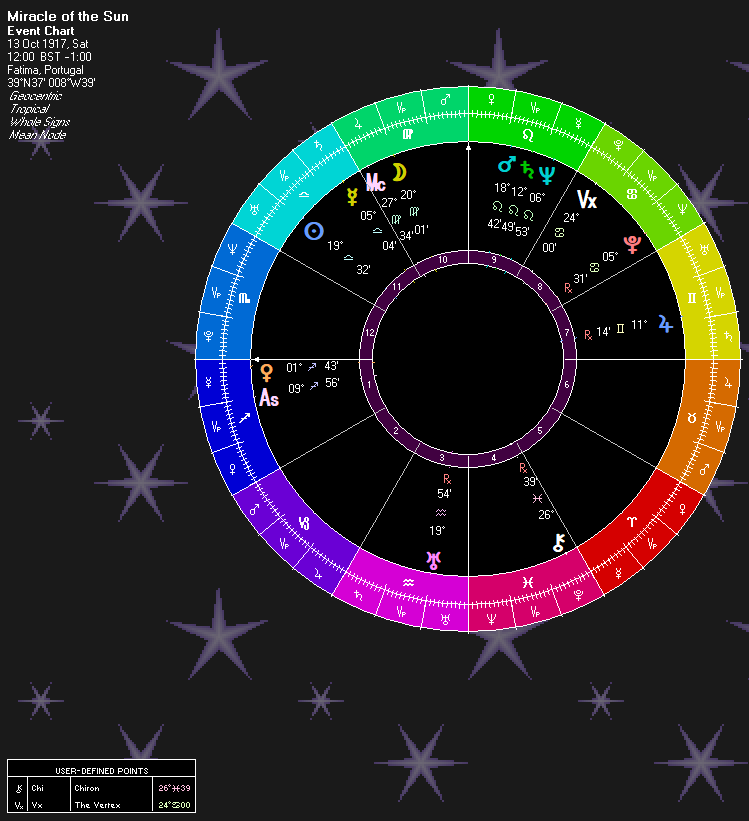
Moon is semisextiles Neptune which means:
Looking (moon) at the sky (neptune).
Focusing (moon) upward (neptune).
Seeing (moon) a vision (neptune).
A Mother (moon) who's floating (neptune).
Venus ingresses Sagittarius to semisextile Sun (Venus’ only planetary aspect). Venus is the East planet (the planet in a later sign) and Sun is West. In the semisquare, this puts Venus in the Venusian and Jupiter arm of the aspect, and Sun is Uranus and Pluto. Thus, this aspect is read as “Sudden appearance (Uranus) of a beautiful/loving (Venus) Immortal (Sun) virgin (Jupiter) female (Venus) apparitian (Pluto).” Or, because Venus is about color, “Miraculous (Uranus) Colors (Venus) of a Large (Jupiter) Mysterious (Pluto) Sun.”
Venus is in early Sagittarius which is subruled by Mercury. This denotes the media attention this miracle got.
Sun is in 19 Libra. “Freedom (Uranus: Ruler 1) of Bounds (Saturn: Ruler).” Thus the Sun’s miraculous movement.
Sun also makes a trine to Uranus. Uranus is “miracle.” Sun is “Sun.” Uranus is East, Sun is West. East is of Mercury and Mars, West is of Mercury and Uranus. With the Mercury subtones, the trine in this chart is speaking of miraculous Sun that is written about and controversial. Uranus is also about movement. So, read the above to show a moving sun.
Sun (East) makes a semisextile to Moon (West). Eastern arm of the semisextile is of Mercury and Mars; West is of Neptune and Pluto. “Immortal Mother (Sun + Moon) communicating (Mercury) pain (Mars) and having compassion (Neptune) on the weak and crippled (Pluto);” or “revealing (Neptune) Mysteries (Pluto).” The Immortal Mother can also be “exposing sin and foolishness.”
Chiron is still in Pisces showing wounds from people’s unbelief. This time, it opposes the Moon directly applying the wounds to a mother. It also sits on the Imum Caeli, oppossing Medium Caeli. Thus, the Mother (Moon) is in Heaven (Medium Caeli = “Middle of Heaven”). The Imum Caeli shows where the native is from and what leads them to Heaven. This is Chiron. For the Event and Apparition, the interpretation is the mission is healing and penance of the wounds from sin to lead people to Heaven.
This ends my series on Fatima. Yes, I missed the September appearance, but the read is much the same as the previous ones and the event did not have anything to differentiate from the others. Full natal chart reads of the seers is on the backburner. And, I do have primary sources to go through regarding Fatima. If I see anything interesting that is chartable, I will do so.
Thanks for reading Astrology of the Saints! Subscribe for free to receive new posts and support my work.