
FATIMA: The Valinhos Apparition
The seers get an unexpected appearance

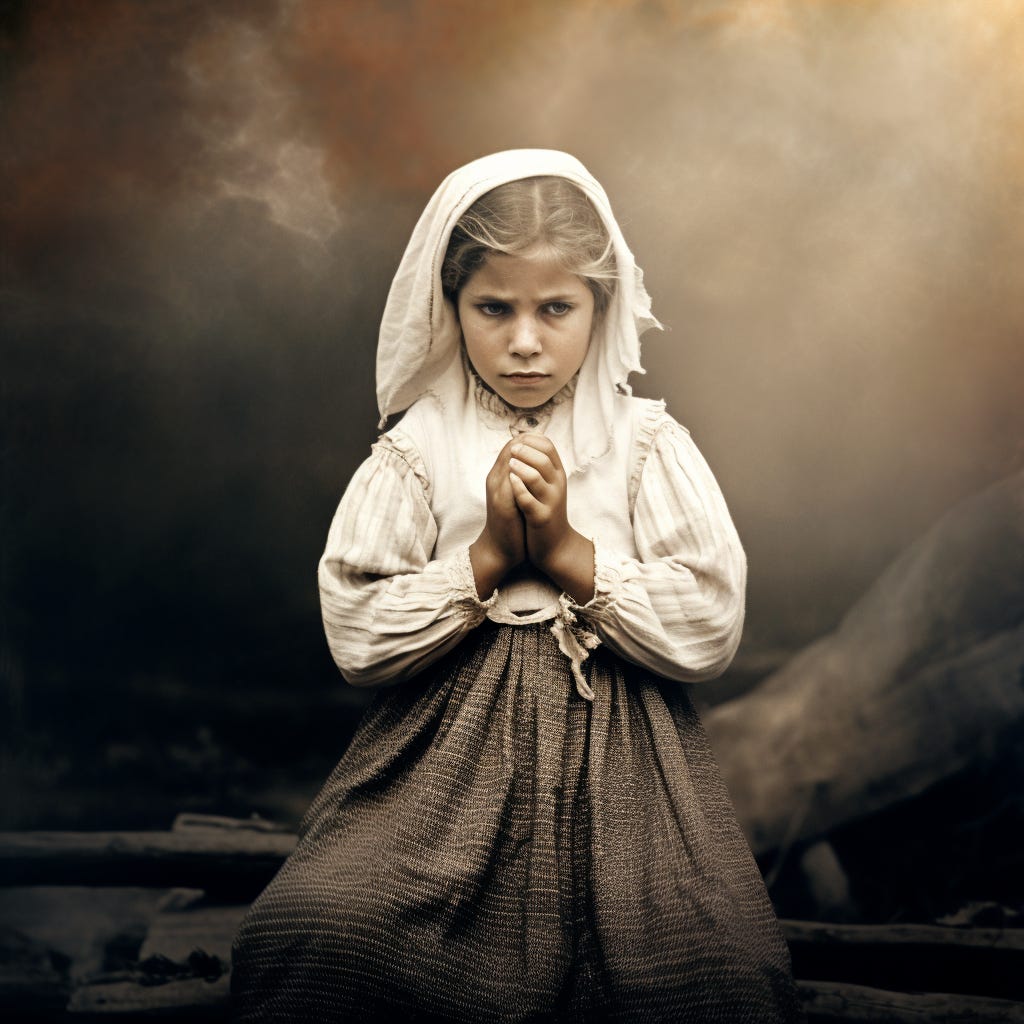
The Valinhos apparition is unique for appearing off schedule and place.
It was about four o'clock when Lucia first noticed the strange atmospheric changes in the air that had preceded the earlier apparitions in the Cova da Iria. There was a sudden freshening of the air. The hard glare of the sunlight died. There was, unscheduled, and contrary to the fair afternoon, a dramatic flash of lightning.22 Our Lady, Lucia thought; who else could it be? The freshened air whipped anxious hope alive. Francisco stood still, his large eyes wide with expectation. He did not speak. He only waited. His brother, John, looked puzzled, uncertain, until Lucia spoke with sudden excitement.
"John—please go get Jacinta! Our Lady's coming—please!"
There was no action from John. He wanted to see this wondrous, celebrated Lady, too. He had no intention of being cheated out of that.
"I'll give you money, John—here. Take this and there will be more when you come back. I have to have Jacinta here."
A practical fellow, John pocketed the money first, then sprinted for home and his little sister. His mother met him at the door.
"All this excitement? Why?" Olimpia wanted to know.
"Lucia wants Jacinta to go to Valinhos, Mama—rightaway. It's important. Very important, Mama."
"Lucia is a priest or something? She must always have her sacristan?"
"It isn't that, honest. Lucia says she has seen signs our Lady is coming. She gave me money, even. Here, look; just to come for Jacinta."
Just how impressed Olimpia was at this moment has not been recorded. But she did say to her son, "Go with God, my boy; Jacinta is at her godmother's house." And her own curiosity took her after them toward Valinhos. However, she delayed on the way and did not arrive in time. As for John, he has testified that his only tangible profit was the cash in his hand. He saw no miraculous Lady, although he later professed to have heard some strange sound like a rocket's ascent, when Lucia at the conclusion of this apparition, called out, "Look, Jacinta—she's going away!"
But for the privileged children, here, in the plain field called Valinhos, it was gloriously real. A few moments after Jacinta's arrival, their Lady appeared above a tree a little taller than the holm oak at the Cova da Iria. Beholding her, they rocked in ecstasy. And, as always, it was only Lucia who spoke in that flat, repeated formula that never seems equal to these great occasions.
"What do you want of me?"
And our Lady's unvarying first reply: "Come again to the Cova da Iria on the thirteenth of next month, my child, and continue to say the Rosary every day."
Again Lucia requested the Lady to bring to these hills a miracle so that all would know she came from heaven. Please do this, she requested, since they were so tired and so punished from being disbelieved.
"I will," the Lady promised. "In October I will perform a miracle so that everyone can believe in the apparitions. If they had not taken you to the town (meaning Ourem), the miracle would be even greater. St. Joseph will come with the Holy Child to bring peace to the world. Our Lord will come to bless the people. Our Lady of the Rosary and Our Lady of Dolors will also come at that time."
"Yes," said Lucia, "yes"; then remembering the request of Maria da Capelinha, she asked, "What are we to do with the offerings of money that people leave at the Cova da Iria?"
"I want you to have two andors [frames to carry statues] made," the Lady instructed, "for the feast of Our Lady of the Rosary. I want you and Jacinta to carry one of them with two other girls. You will both dress in white. And then I want Francisco, with three boys helping him, to carry the other one. The boys, too, will be dressed in white."
Lucia accepted these instructions humbly and thankfully, then fervently asked for the cure of the sick who had begged her intercession.
"Some I will cure during the year," the Lady said; then gazing down at them, she added, sadly, "Pray, pray very much. Make sacrifices for sinners. Many souls go to hell, because no one is willing to help them with sacrifice."
That was all, and the Lady left them, rising in the air—moving steadily, steadily toward the east until she was gone, or at least unseen, in the distant sky.
Ordinarily, in the Cova da Iria, when the people in heedless hunger for souvenirs, had grasped and torn at the leaves and twigs of the little oak, the children had challenged their bad manners and reproved them. But today, at Valinhos, they were the ones who, for reasons of their own, cut from the tree and carried away the branch on which their Lady's white mantle had rested. Jacinta and Francisco gained possession of the precious branch, and leaving Lucia and John to care for the sheep, they hurried home in triumph. At the Santos house, standing in front of the door with their neighbours, they found Lucia's mother and her sister, Maria dos Anjos, who has described this scene for us:
Jacinta, all excited, rushed up to my mother and said, "Oh, Aunt, we saw our Lady again! We saw her at Valinhos!"
"Ah, Jacinta," my mother said, "when will these lies ever end. Do you have to be seeing our Lady all over creation? Wherever you go?"
"But we saw her," Jacinta insisted, then held forth the branch she was holding in her hands. "Look, Aunt, please—this is where our Lady put one foot, and here is where the other foot was."
"Let me see it, let me see it," my mother said.
She took the branch and held it close to her face. Puzzled, she said, "What smell is this? It is not the smell of roses, but it is very lovely. What could it be?"
Naturally, we were all curious. All of us smelled the branch, and all of us found the scent of it very pleasant. Aft a while my mother took it inside and placed it on a table.
"It had better stay here," she told us, "until we are able to find someone who can tell us what it is."
But that evening, I remember, we could not find the branch when we wanted it. We did not know who had taken it. Still, I remember that my mother was impressed, and I think it was from then on that she began to be kinder to Lucia. My father softened, too, so that both of them defended Lucia from then on, when others tried to torment her. Leave Lucia in peace, they used to tell us, for what she says might after all be true.
Actually, there was never a mystery of the missing branch. The adroit and agile Jacinta took it without apology when her aunt's back was turned, and brought it home to her parents, for whom she had intended it all along. Ti Marto recalls that late afternoon:
That afternoon I had made an inspection of the land and around sunset I started home. I was almost there when a man came up to me and said, "Well, Ti Marto, I see that the miracle business is going well."
"What do you mean?" I said.
"Why, our Lady has just appeared again to your little ones and Abobora's girl. I tell you, Ti Marto, there is something special about your Jacinta. She wasn't with the other two at first, and it was only when they called her, that our Lady appeared."
To this I did not know what to say. I merely walked into my own yard to think it over. My wife was not there. I walked into the kitchen then and sat down. Then who should come in but Jacinta, looking gay as a bird, and she is carrying a branch, about so big, in her hands.
"Papa! Papa!" she said. "Our Lady appeared to us this afternoon at Valinhos."
Even while she was saying this I could smell a more beautiful essence than I can describe. I reached for the branch and said to Jacinta, "What is this?"
"It is the branch our Lady stood upon," she said.
I raised it to my face, but, strangely now, the smell of it was gone.
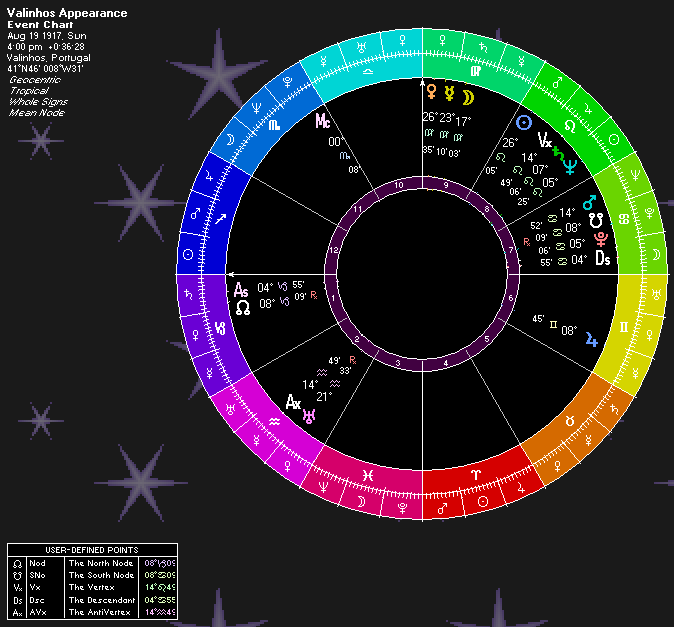
Moon, Mercury, and Venus are all in Virgo and conjunct and parallel each other. The significance is obvious. “Message from a Virgin Mother.” Venus, along with it’s female symbolism, is also about sweet smelling fragrance. In the above account, we hear of the sweet smelling branch Our Lady stood on. This phenomenon is known as the “Odor of Sanctity.” This is where a sweet smell emits from holy beings, as opposed to the foul and burning smells of evil beings (“skunk ape”). St. Gemma and St. Pio both also manifested the odor of sanctity.
Sun and Uranus are still in opposition. This is the only aspect the Sun makes. Remember: Uranus also represents thunder, such as the loud sound that immedietly precedes The Lady’s appearance. Uranus being aspected with the immortal Sun shows the connection between the two. Here, Uranus makes tight aspects to the Ascendant axis, and sits on the Nodal axis.
CHIRON
Something I have not touched on is that Chiron is late in Pisces all through these apparitions. Pisces Chiron is a lack of faith in God and the divine. It is also a sense of feeling betrayed. This expresses The Lady’s message perfectly: Men do not believe in God and continue to betray and harm her and Jesus by sinning. Chiron is anaretic at 28-29 degrees through these apparitions. This means the faithlessness and sinfulness harming Jesus and Mary is coming into sharp focus. Fatima is showing a light on these wounds.
At Valinhos, Chiron is in opposition to Venus. It is about healing the wounds with a relations with The Lady. She asks to build a shrine, and make sacrifices for sinners. Chiron is in aspect to Venus at the first appearance, as well.