
Dogma of the Virgin Mother's Assumption
Some work with Juno, Vesta, Ceres, and Uranus

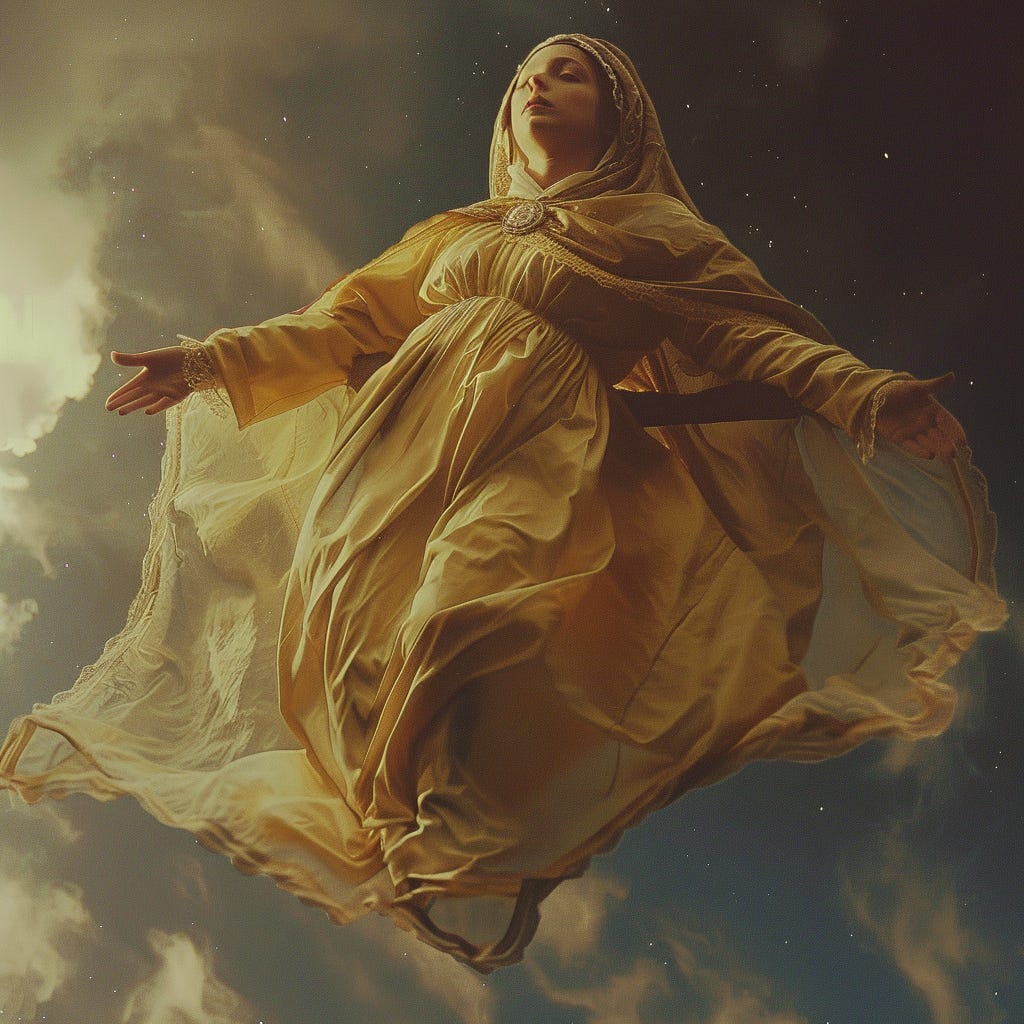
Mary’s Assumption into Heaven is the newest dogma of the Church. It was proclaimed on November 1, 1950. This is not to say it was not believed before then. It always was, as evidenced by the Church proclaiming it as dogma. A dogma is a truth revealed by God. It is something that is eternally true and thus cannot be changed. So, a later pope cannot come along and say it is not true. Other dogmas of the Church include the divine truths of Jesus and God. Mary’s Assumption is on the same theological level as Jesus being God and God the creator of the earth.
The Assumption is that Mary was bodily taken into Heaven. This means Mary’s body was preserved and still exists eternally. In other words, Mary (like Jesus) is an eternally existing human in a human body. Mary is not a “spirit” right now. She has a body. Mary joins Jesus, Enoch, and Elijah as people taken into heaven bodily. Moses is also likely because he was seen at the Transfiguration with Elijah and there is a tradition of his assumption. Another possibility, that is simply a pius theory without Biblical basis is Joseph, Mary’s husband. Of these, only Moses died when assumed (and Joseph, with his strong tradition of a Happy Death). Jesus died, but ressurected and walked the earth for days before being assumed. It is open conjecture whether Mary died before being assumed.
The assumptions are important to show the importance of the body in Christianity. Christianity is a physical religion that regards the body as important, if not holy. They are demonstrations that the afterlife is not entirely etheral, but is also physical.
MUNIFICENTISSIMUS DEUS was the announcement of the Assumption of Mary. It was done by Pope Pius XII.
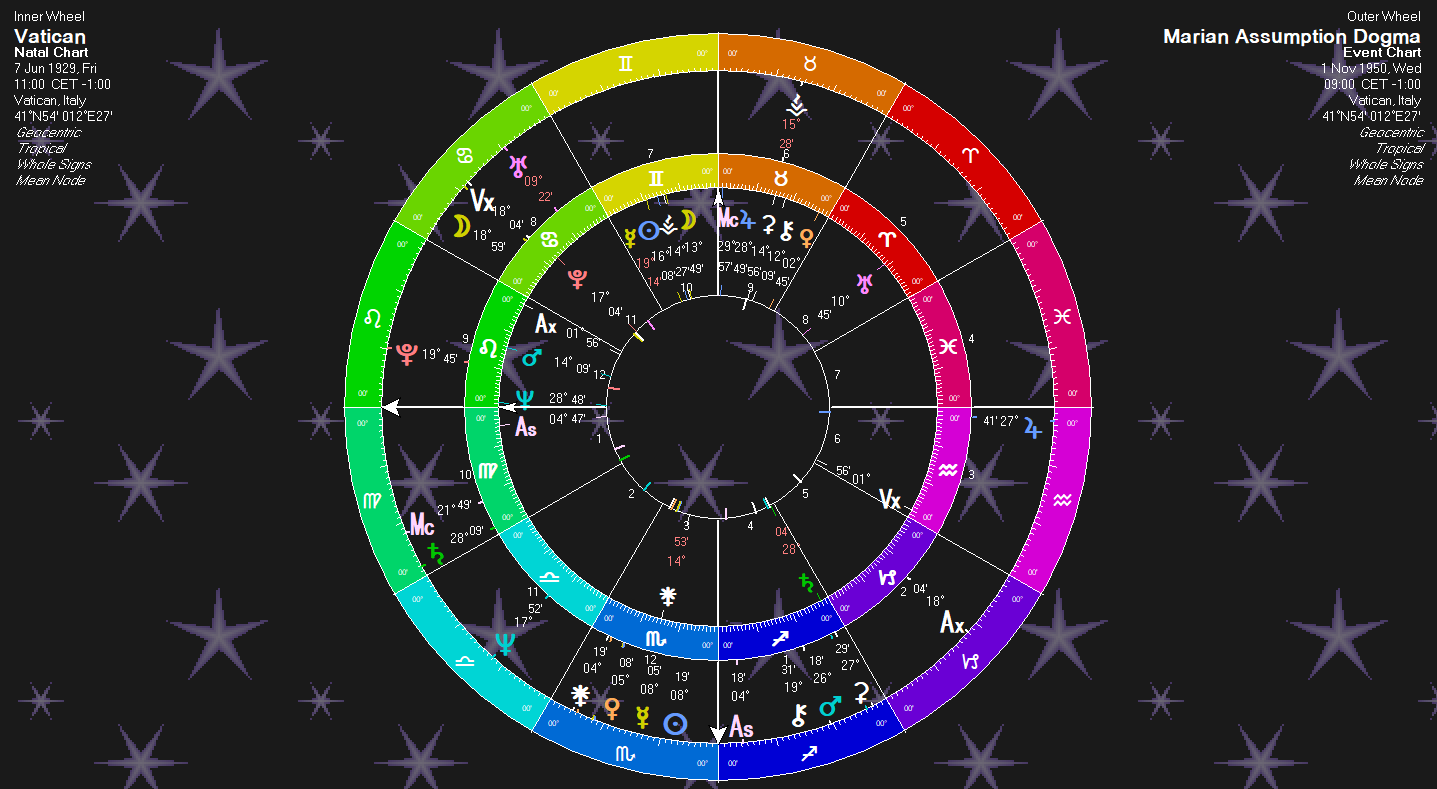
Sun and Mercry conjunct at 8 Scorpio gives us “Monarch (Sun) Declares (Mercury) Church (Neptune) Dogma (Saturn).” Uranus trines the Mercury and Sun conjunct. Trines are of Mercury and Uranus. Uranus is also the third subruler of Scorpio in this degree. Uranus is “ressurection,” “translation,” “revivify,” and “transform.” Uranus also is about all forms of movement and transportation. The two Uranus’ are in square, while both aspect transit Mercury and Sun. So, the magnitude of Uranus in this chart gives enough space to describe the assumption (“translate and travel to Heaven”).
There is a fascinating aspect with the Vestas and Cereses aspecting Juno. Ceres is described, by Martha Lang-Wescott, as being of mothers and food and nuturing (home). In other words, the same associations as the Moon. Vesta she leans on the history and mythology of Vesta, the virgin Roman goddess of virginity (Jupiter) and home (Moon). If Vesta is about priestesses who took an oath of celibacy, the significance is immediatly clear on this chart: “Virgin (Vesta) Mother (Ceres) Dogma (Juno).” We can also create the same with the Ceres-Saturn-Neptune aspect on the chart: “Virgin (Jupiter) Mother (Ceres) Translation (Uranus) Catholic (Neptune) Dogma (Saturn).”
The above is a good exercise to see the possibilities in the other major asteroids. Ceres may be another Moon, Vesta might have Jupitarian associations. In the same way I discovered Juno is Saturnian, I hope to find the proper associations with Vesta and Ceres. All human experience is in the planets, Mercury through Pluto, and Sun and Moon. So, the asteroids can only have the same planetary associations. Their purpose is to help see what is happening on a chart. The more holes you can poke in the wall, the more you can see what is behind the wall.