
Birth of Jesus
The first of my Gospel articles

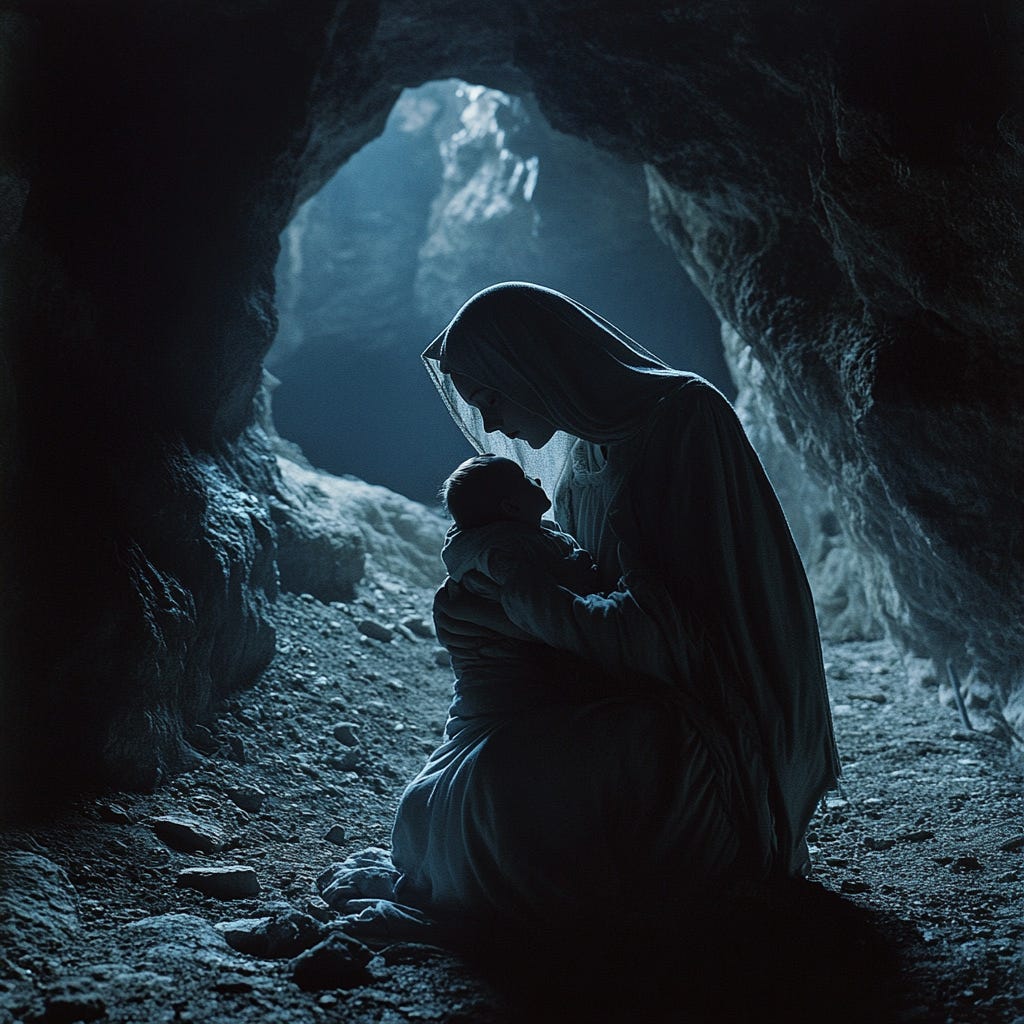
Jesus was born in Bethlehem (literally “bread town”) inside a cavern home where he was placed into a feeding trough due to crowding in the cavern home. Jesus later taught that eternal life is through consuming him as bread. An interesting note is that much of fairy and alien lore has bread offerings (often with wine). The documentation is all well past the time of Jesus, so, it may all be a mock Christ communion. But, I think it shows Jesus to be a part of The Other that he instituted a religion based on consuming God as bread.1 Jesus was born to a teenage Mary who carried Jesus in her womb for nine months. Jesus being inside of Mary was her salvation, so, Jesus must be inside us for our salvation. This is accomplished by us eating him.
Jesus birth was to a virgin. He never exited Mary through the birth canal. Rather, he appeared outside her, thus preserving her virginity in every sense (before, during, after birth; virginitas ante partum, in partu, post partum). This is recorded in the Protoevangelium of James and attested to by the early Christians. The Catholic Church, in Lumen Gentium 57, reaffirmed that Mary was a virgin during and after birth.
Here, is where I may be asked why I chose the Christmas birth date. The reason is “Why not?” There are many alternative dates, but they all start with the baseless assumption that the Christmas date is wrong. The alternative dates seem to be a response to the “Christmas is pagan” line. Any claim of anything Catholic being pagan is not something I take seriously, since this is the response invented by protestants in the Protestant Revolt in the 1500s. Instead, I want to know why the only tradition for Jesus’ birth date is the Christmas one. There is no line saying Jesus was born in September, or April or anything other than Christmas.
I do not have the education to make a historical or chronological argument for Jesus’ birthdate. Ancient and Biblical chronology is a steep, difficult subject. Rather, I am making the argument based on astrology. However, you can find academics supporting the Christmas date. You can look there, not here, for historical and chronological reasons for the Christmas date. Such articles are few, but they are out there (the majority date is September 11).
I started with the Christmas date for Jesus, poked around with other dates, but continually found the Christmas date to be astrologically strong. It is so strong, I am certain Jesus was born Christmas in 3 BC. My colleague, Ian Murphy, was impressed with the chart, as well, and made his own read in his own style of the chart, previously published here.
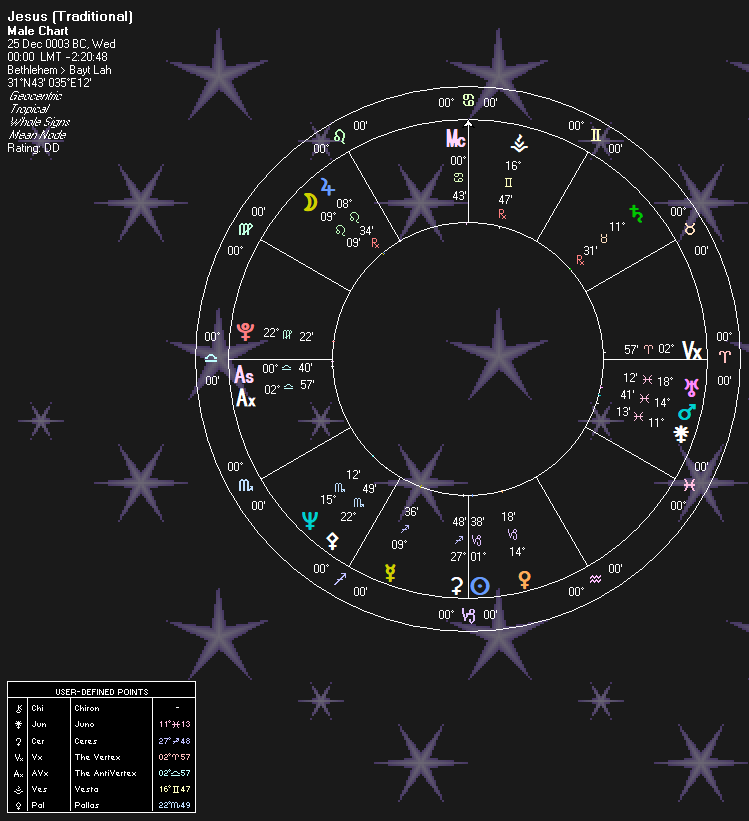
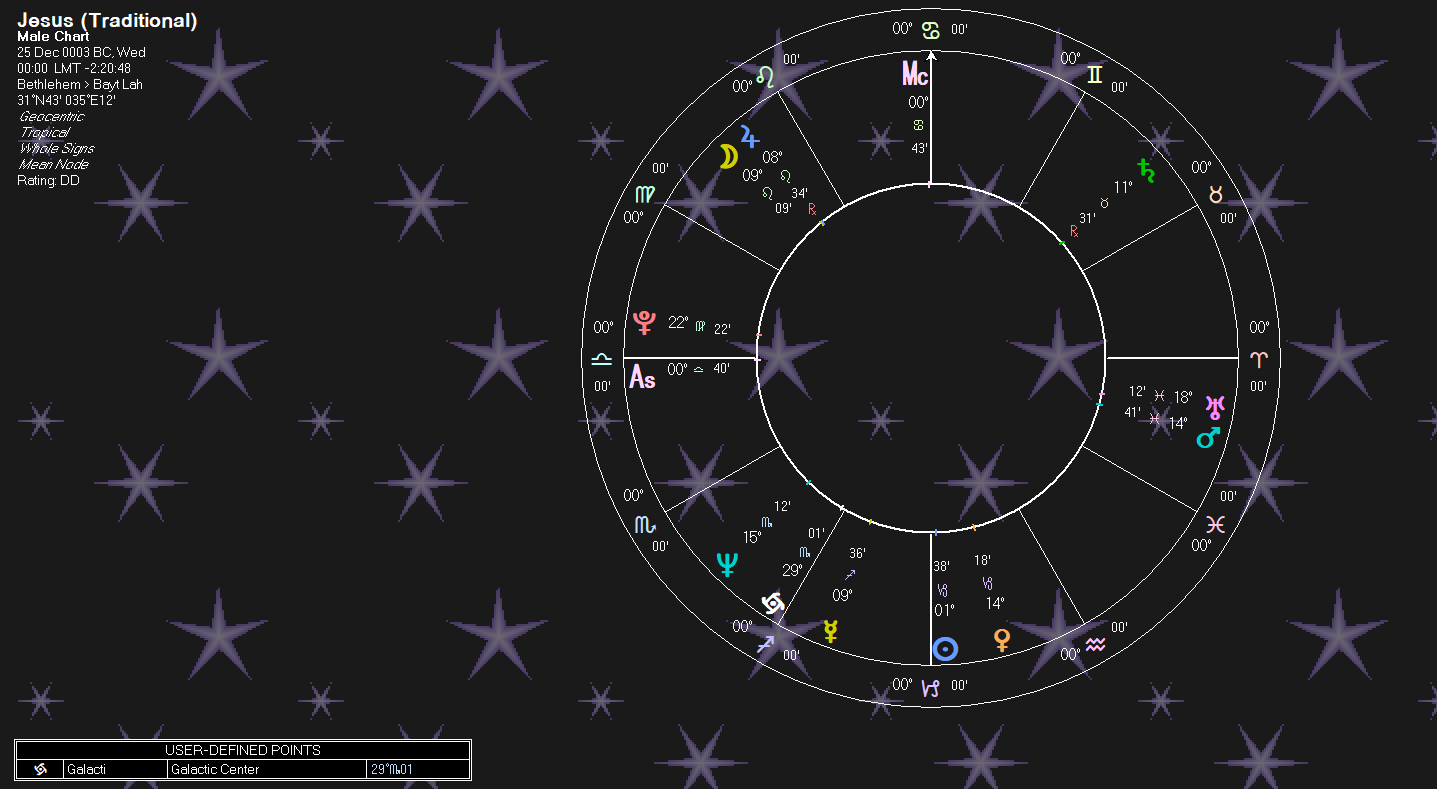
Moon-Jupiter = Virgin Mother; King Appears; Godly Bread; Immaculate Conception
Uranus-Mars conjunct = Performs (Mars) Miracles (Uranus), Performs (Mars) Resurrection (Uranus)
Capricorn Ingress Sun = Savior (Neptune) Born (Sun).
Neptune semisquare Sun = Savior (Neptune) Born (Sun).
Moon-Pluto semisquare and parallel = Mystical (Pluto) Bread (Moon).
Mercury-Moon trine = Called (Perfect [+Jupiter]) Bread
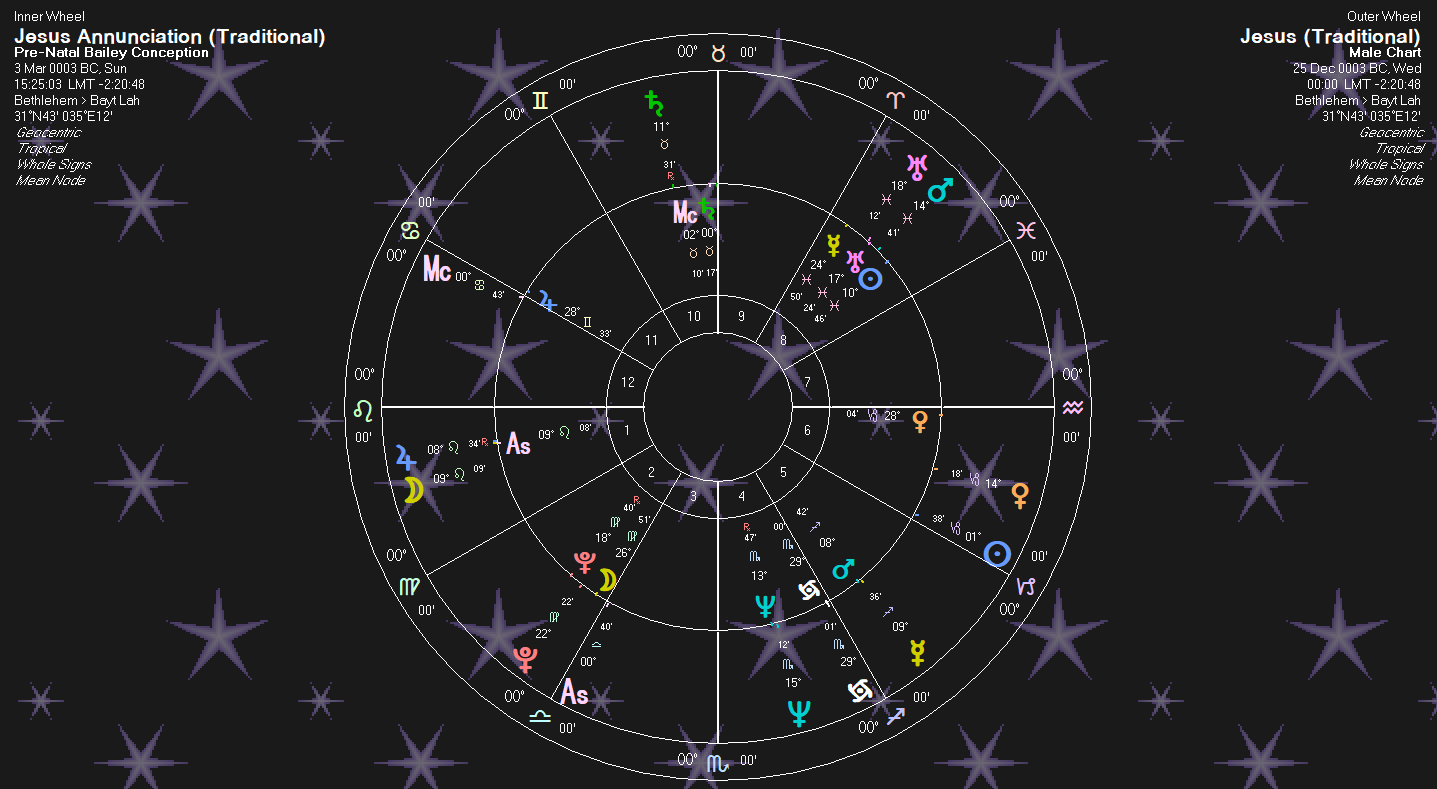
Validating these ancient charts are crucial. The chart must work with other charts. Charts are validated through important dates. But, with the ancient charts, we do not have known dates. However, with Jesus we do have important known dates. His various mystical marriages. Marriage is always an important date. With Jesus, we have a few of them with known dates. All of these have a Juno conjunct. Juno, a Saturnian asteroid, moves faster than Saturn, so this helps affirm a much narrower date than if it was Saturn conjuncts.
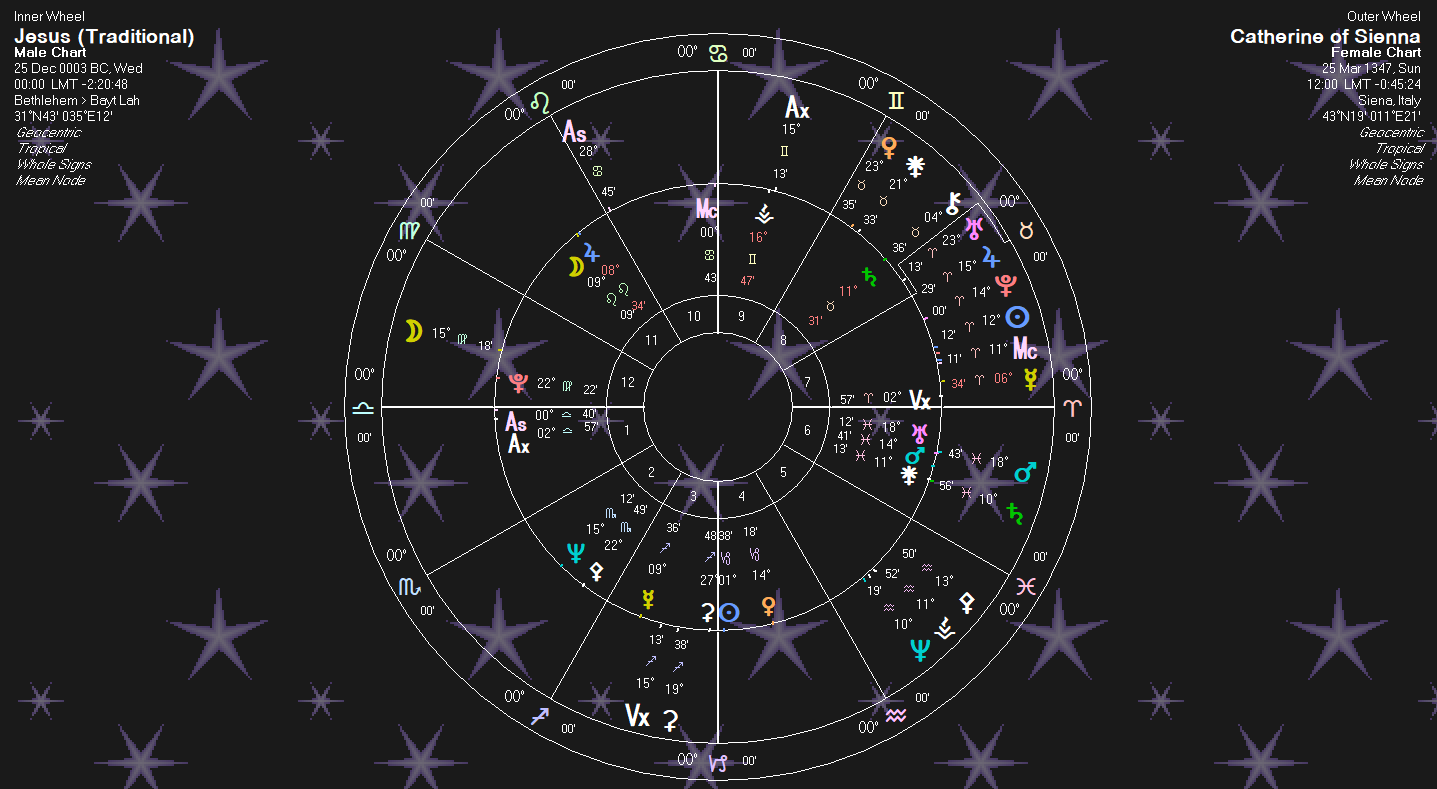
St. Catherine of Sienna is one of, if not the first mystical marriage to Jesus recorded. Here, we can see her Saturn (Marriage) conjunct Jesus’ Juno. It may also be noted the stigmatist has her Mars conjunct Jesus’ Uranus and Mars.
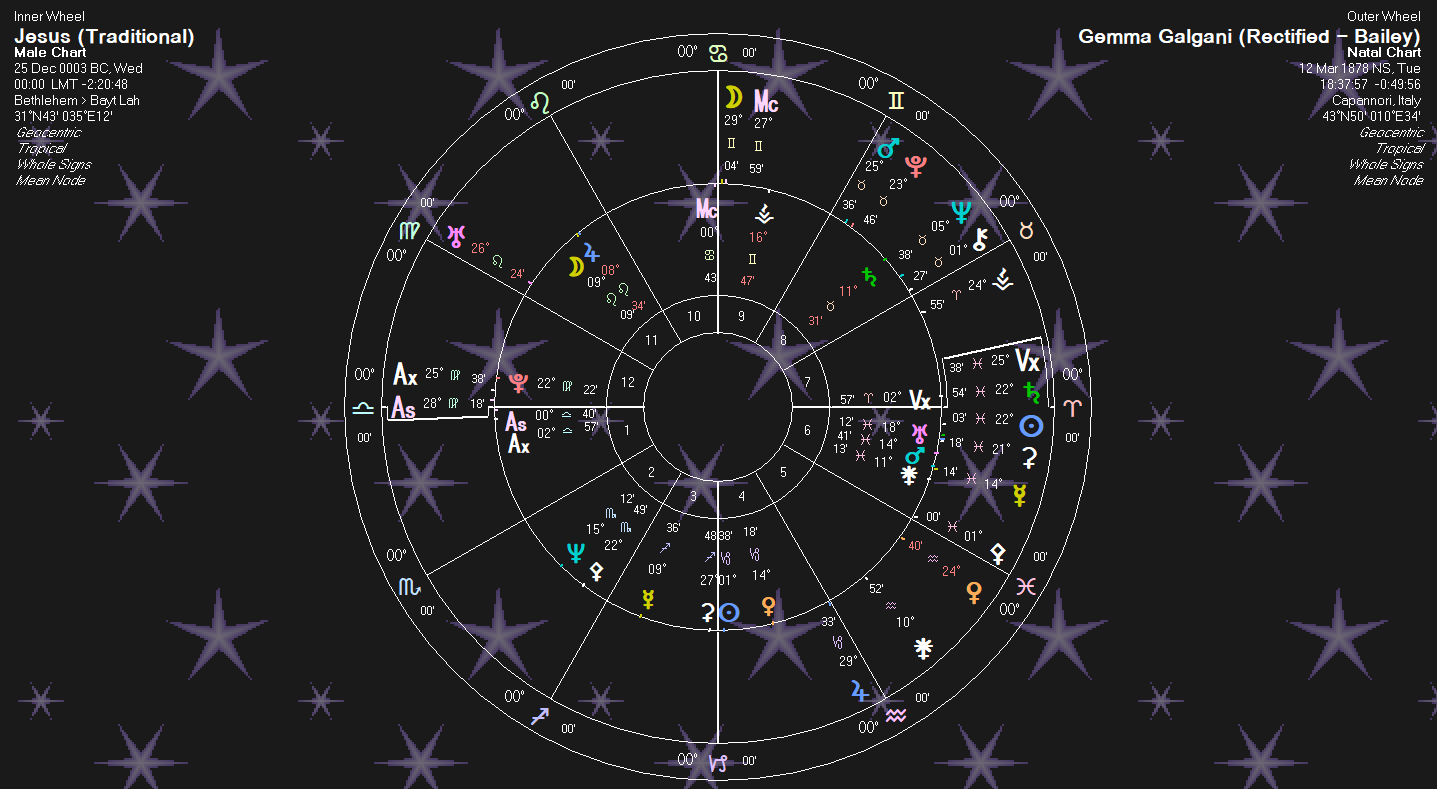
For Gemma Galgani, who had an intense devotion to Jesus, was a stigmatist, and had a mystical marriage to Jesus, her Moon opposes Jesus’s Sun and her Juno semisextile’s Jesus’ Juno. Her Juno is conjunct the Crucified Jesus’ Juno (Jesus always appeared to Gemma crucified).
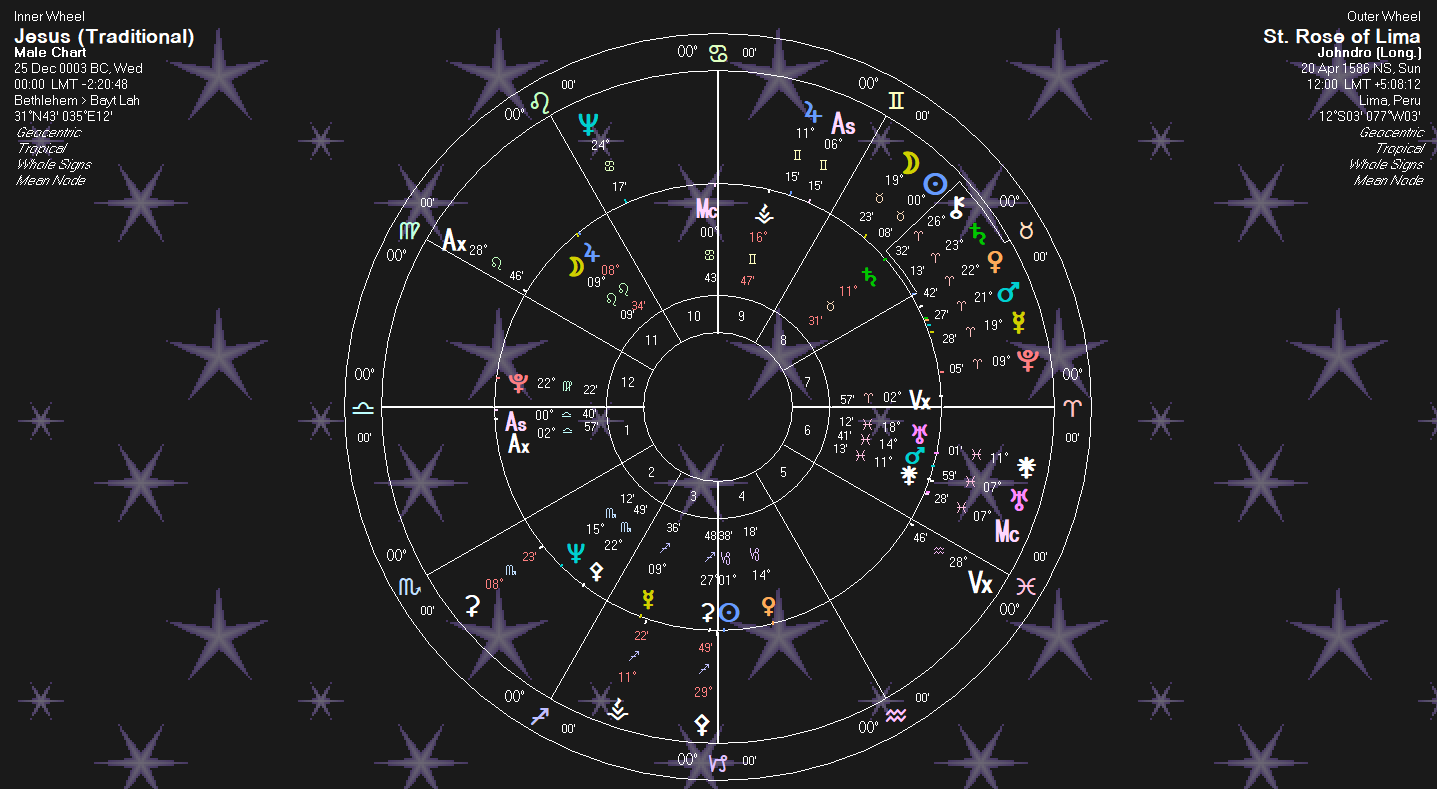
St. Rose of Lima is another with a mystical marriage to Jesus. Her Juno is conjunct Jesus’ Juno.
CRUCIFIXION
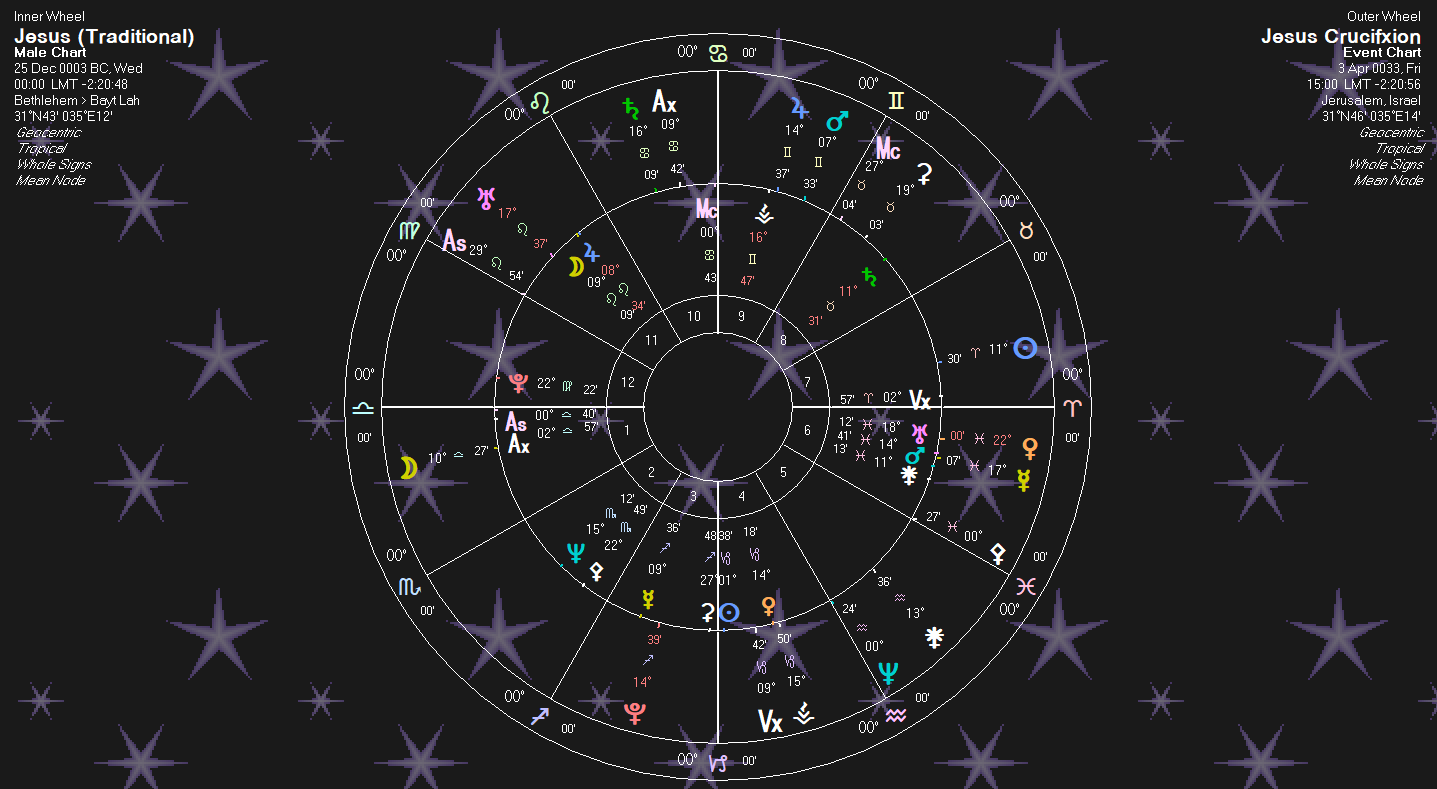
I will deal with the death and ressurection charts in the future. For now, I am only using the death chart to affirm the natal chart. Jesus gets a death transit with the eclipse. The Sun transits exactly between his Saturn and Juno, semisextiling both. “God (Sun) is dead (Saturn-Juno).” The Moon quincunxes both while opposing Sun. So, we get an observation (Moon) of the death. We can also read it as “Bread (Moon) of Life (Sun) Dies (Saturn-Juno).”
The transitting Ascendant is semisquare transitting Saturn to show the time of death.
There’s a million other things, but this should suffice to show that I have the correct charts. I will cover the Ressurection in another post and will not show the chart yet.
GALACTIC CENTER
The Galactic Center is a fascinating point. I’m still studying it for natal charts. St. Gemma was born with her MC-IC axis on it, for example. I have my Ascendant on it. Best I can figure, is that on angles it acts as an information conduit or a spiritual conduit. But, in mundane astrology, the Galactic Center is a timer for epochs.
Jesus was born with an anaretic Galatic Center. Obviously, this is far from a unique placement for him. The Galactic Center takes 2,000 years to traverse a sign. Here, it is prepared to leave Scorpio in a few decades. I will leave it for a future subscriber post to reveal what happens when it ingresses into Sagitarius and what it may mean when it finally leaves Sagitarius.
Jesus’ Galactic Center is at a semisquare with Venus. Perhaps this shows a Child (Venus) from Heaven. The Galatic Center anciently was known as the gate between the living and the dead. Neptune is also at a 15 degree aspect (“quin”) with the Galactic Center. This may indicate a Savior (Neptune) from Heaven. Neptune is slow enough to be parked there for a minute, so this is more of a mundane astrological aspect than a natal. It might be showing now is the time a Savior is born.

See Joshua Cutchin’s “Trojan Feast” book for an exhaustive documentation of paranormal beings offering bread to their subjects.